Everlyn Family Farm
Property Overview
| County | Polk County, Missouri |
| Coordinates | 37.5215 N, 93.3397 W |
| Zoning | Unincorporated / Agricultural |
| FEMA Zone | Zone X (Minimal Flood Hazard) |
| Watershed | Slagle Creek, 0.35 sq mi drainage |
| Road Access | Existing (needs culvert + cattle guard) |
| Well | Drilled, 445 ft deep, 50+ GPM, pump installed, spigot active |
| Power | Pole with meter at road |
| Internet | Windstream fiber available at premise |
| Stream | Slagle Creek runs through property |
Land Use Allocation
| Zone | Area | Purpose |
|---|---|---|
| Grazing Grounds | ~12 acres | Cattle pasture, rotational grazing |
| Dave & Kami | ~2 acres | Home site, yard, chicken run |
| Renn & Vanessa | ~1.5 acres | Home site, yard, chicken run |
| Ciarra | ~1 acre | Future home site |
| Hay Field 1 | ~1.71 acres | Hay production |
| Hay Field 2 | ~0.83 acres | Hay production |
| Sheep/Livestock Field | ~2 acres | Sheep or other livestock |
| Communal Garden | ~7,775 sq ft | Vegetable production for 3 families |
| Shop | ~7,775 sq ft zone | Equipment, woodworking, storage |
| Gathering Place | ~9,800 sq ft | Community building, guest quarters |
| Remaining | ~10+ acres | Timber, pond, firepit, comm tower, roads, future expansion |
Water & Flood Data
| Flood Event | Return Period | Peak Flow |
|---|---|---|
| 50% AEP | 2-year | 138 cfs |
| 10% AEP | 10-year | 396 cfs |
| 2% AEP | 50-year | 699 cfs |
| 1% AEP | 100-year | 834 cfs |
| 0.2% AEP | 500-year | 1,150 cfs |
Families & Home Sites
| Home Size | 3,400 sq ft, 2-story country farmhouse with attached garage + optional loft |
| Construction | ICF (Insulated Concrete Forms) -- entire home acts as storm shelter |
| Foundation | Slab-on-grade or basement (pending drainage assessment at site) |
| Cold Storage | Walk-in cold room inside home (CoolBot + window AC, ~35-40°F) |
| Energy | Solar array + battery bank, backup generator, grid-tied |
| Water | Line from main well, dedicated pressure pump |
| Septic | Conventional system (pending perc test) |
| Internet | Windstream fiber direct, Starlink backup, serves as distribution hub (UniFi P2MP) |
| Chicken Coop | On-site with fenced run, egg layers + meat birds |
| Timeline | Year 1 -- sell current home, rent during build, move in when complete |
| Phase 1 | Sell home, purchase trailer, place on site |
| Phase 2 | Build permanent home (type TBD) |
| Water | Line from main well, dedicated pressure pump |
| Septic | Conventional system (pending perc test) |
| Power | Extended from main pole |
| Internet | Wireless from Dave's home (UniFi P2MP) |
| Chicken Coop | On-site with fenced run |
| Solar | TBD -- their decision |
| Timeline | TBD -- timeline unknown |
| Near-term | Run utility stubs (power, water) to lot boundary |
| Home | Style and size TBD |
| Chicken Coop | On-site when she builds |
Legal & Property Structure
Priority: Before Building Attorney Required
3.1 Property Subdivision
| Parcel | Owner | Details |
|---|---|---|
| Parcel 1 | Everlyn Family Living Trust | ~2 acres -- Dave & Kami's ICF home (residential) |
| Parcel 2 | Renn & Vanessa (sale) | ~1.5 acres -- residential, subject to ROFR and buy-back (see 3.7) |
| Parcel 3 | Ciarra (sale, future) | ~1 acre -- residential, subject to ROFR and buy-back (see 3.7) |
| Parcel 4 | Everlyn Family Living Trust (land stays in Trust; operated by Everlyn Family Farm LLC) | ~27.8 acres -- all agricultural land, shared infrastructure, buildings |
Subdivision Process
- Hire a licensed surveyor to create a subdivision plat with exact boundaries for each parcel
- Submit plat to Polk County for approval (check if a simple lot split or full subdivision plat is required -- under 4 lots in rural MO is often a simple split)
- Record the plat with the Polk County Recorder of Deeds
- Each parcel gets its own legal description and tax ID
- Sell Parcels 2 and 3 to Renn & Vanessa and Ciarra at agreed-upon prices with proper purchase agreements
3.2 Everlyn Family Living Trust
| Detail | Description |
|---|---|
| Trust Name | Everlyn Family Living Trust |
| Grantors / Trustees | David Perez & Kami Perez (co-trustees) |
| Trust Assets | Parcel 1 (residential home), Parcel 4 (farm land -- land must remain in the Trust), 100% ownership of Everlyn Family Farm LLC |
| Beneficiaries | Dave & Kami during lifetime, then children per trust terms |
| Purpose | Estate planning, probate avoidance, asset protection, succession planning |
Why a Trust?
- Probate avoidance: Assets in the trust pass directly to beneficiaries without court proceedings -- faster, cheaper, and private.
- Control: The trust owns Everlyn Family Farm LLC, so Dave & Kami retain full control of all farm operations and land decisions.
- Asset protection: Combined with the LLC, creates a two-layer shield between personal liability and farm operations.
- Succession: If something happens to Dave & Kami, the trust document spells out exactly who inherits the farm and how it's managed.
- ROFR enforcement: The trust holds the right of first refusal on Parcels 2 and 3, ensuring the land recovery provisions survive regardless of individual circumstances.
Everlyn Family Living Trust owns Parcel 1 (home) + Parcel 4 (~27.8 acres of farm land -- land stays in the Trust) + 100% of Everlyn Family Farm LLC (which operates the farm). Renn/Vanessa and Ciarra own their residential parcels individually but work on the farm as employees of the LLC.
3.3 Everlyn Family Farm LLC
| Detail | Description |
|---|---|
| Entity | Everlyn Family Farm LLC -- registered in Missouri |
| Ownership | 100% owned by the Everlyn Family Living Trust |
| Property | Parcel 4 remains in the Trust; LLC operates the farm (all agricultural operations, buildings, infrastructure) |
| Purpose | Agricultural operations: livestock, dairy, orchard, garden, and shared infrastructure |
| Managing Member | Kami and David Perez (as trustees of the Everlyn Family Living Trust) |
| Tax Status | Single-member LLC (disregarded entity) -- farm income on Schedule F of Dave & Kami's personal return |
Employee Structure
Renn, Vanessa, Ciarra, and Ciarra's older kids can be hired as W-2 employees of Everlyn Family Farm LLC. This provides several advantages:
- Tax deduction: Wages paid to family employees are a deductible farm expense on Schedule F, reducing the farm's taxable income.
- Clean relationship: No ambiguity about who owns the farm -- the Trust owns the LLC. Employees contribute labor and receive pay.
- Payroll benefits: Employees can contribute to IRAs or be enrolled in a SIMPLE IRA plan through the LLC. Farm employees under 18 (Ciarra's kids) are exempt from FICA taxes if employed by a parent's sole proprietorship -- check if this applies through an LLC.
- No exit complications: If someone leaves, they stop being an employee. No buy-out, no membership interest disputes. They keep their residential parcel (subject to ROFR/buy-back terms).
As an employer, Everlyn Family Farm LLC must: obtain an EIN from the IRS, register with Missouri for state withholding and unemployment tax, issue W-2s annually, file quarterly payroll tax returns (Form 941), and carry workers' compensation insurance (Missouri requires this for farm employees). Talk to your CPA about the most tax-efficient pay structure.
Operating Agreement Must Cover
- Sole member: Everlyn Family Living Trust is the only member
- Management: Kami and David Perez as co-managing members (as trustees of the Trust)
- Capital contributions: Initial investment from Trust assets
- Shared infrastructure expenses: How well pump, road, power, and comm costs are allocated between the LLC and residential parcels
- Employee policies: Pay rates, responsibilities, seasonal vs. year-round work
- Dissolution provisions: What happens if the LLC is wound down
- Succession: Trust document controls what happens to the LLC if Dave & Kami pass away or become incapacitated
- Liability protection: If a visitor gets hurt on the farm, or a cow escapes and causes a car accident, the LLC is liable -- not personal assets or homes.
- Tax benefits: Agricultural tax exemption for farm purchases (fencing, equipment, feed, seed). Schedule F deductions for all farm expenses including employee wages. Agricultural use property tax assessment on the 27.8 acres (much lower than residential rate).
- Clean separation: Each family owns their home free and clear. The farm is a separate business entity with clear ownership and clear employment relationships.
- No exit drama: If a family member leaves, they're simply no longer employed. The Trust retains full farm ownership. Land recovery provisions (Section 3.7) handle the residential parcel.
3.4 Easements
Since the residential parcels are carved out of a larger property, you need recorded easements for shared infrastructure:
| Easement | Purpose | Who Benefits |
|---|---|---|
| Driveway / road easement | All 3 parcels need access to the public road through the Everlyn Family Farm LLC property | All 3 families |
| Water line easement | Well is on Everlyn Family Farm LLC land -- water lines cross farm land to reach homes | All 3 families |
| Power line easement | Power pole is on Everlyn Family Farm LLC land -- electrical runs cross farm land to homes | All 3 families |
| Internet/comm easement | Fiber and wireless distribution infrastructure | All 3 families |
| Utility maintenance easement | Right to access, repair, and replace utility lines across any parcel | All parties |
These easements must be recorded with the deed for each parcel. They run with the land, meaning they survive even if a parcel is sold to someone outside the family. This protects everyone.
3.5 Shared Expense Agreement
Shared Infrastructure (Split 3 Ways Unless Otherwise Agreed)
| Item | Estimated Annual Cost | Split |
|---|---|---|
| Well pump electricity | $300-600/yr | 3-way equal or by usage |
| Well pump maintenance/replacement | $0-2,000/yr (variable) | 3-way equal |
| Road/driveway maintenance (gravel, grading) | $500-1,500/yr | 3-way equal |
| Perimeter fencing repairs | $200-500/yr | Everlyn Family Farm LLC expense |
| Comm tower / internet equipment | $100-300/yr | 3-way equal |
Document this in the LLC operating agreement or a separate shared services agreement. Include a method for collecting payments (quarterly invoicing, shared checking account, etc.) and a process for handling disputes.
3.6 Insurance
| Policy | What It Covers | Who Carries It |
|---|---|---|
| Homeowner's insurance | Each home -- fire, wind, theft, liability | Each family on their own parcel |
| Builder's risk insurance | During construction -- covers the structure being built | Builder typically carries this, verify |
| Farm liability insurance | Visitors, livestock escapes, products liability (dairy/meat sales) | Everlyn Family Farm LLC |
| Farm property insurance | Barn, shop, equipment, hay, fencing | Everlyn Family Farm LLC |
| Livestock insurance (optional) | Mortality coverage on high-value dairy cows | Everlyn Family Farm LLC |
| Umbrella policy | Additional liability above other policies ($1M+) | Everlyn Family Farm LLC and/or personally |
Farm bureau insurance (Missouri Farm Bureau) is often the best option for combined home + farm coverage. They understand agricultural operations and price accordingly.
3.7 Land Recovery Provisions
Since you're selling residential parcels to family at a favorable price, you need legal mechanisms to recover the land if anyone decides to move. All five provisions below should be included -- they work together as layers of protection. Discuss with your estate attorney and present to all family members before finalizing sales.
1. Right of First Refusal (ROFR)
If Renn/Vanessa or Ciarra want to sell their parcel, the Everlyn Family Living Trust gets the first opportunity to purchase at the same price and terms offered by any outside buyer. This is the most common and least controversial family land protection.
- Seller must provide written notice to the Trust with the third-party offer details
- Trust has 30-60 days to match the offer (set specific timeframe in deed)
- If Trust declines, seller may proceed with the third-party sale
- Runs with the land -- binds all future owners, not just the original buyer
2. Buy-Back Option at Predetermined Price
The Trust holds a repurchase option that can be exercised if the parcel owner wants to sell or permanently vacates. Unlike ROFR, this doesn't require a third-party offer to trigger. The price formula should be fair and pre-agreed:
- Formula: Original purchase price + CPI inflation adjustment + documented improvement costs (permitted improvements only, with receipts)
- Trigger events: Owner lists property for sale, owner vacates for 12+ consecutive months, owner files for bankruptcy, owner dies without heirs who want to occupy
- Exercise window: Trust has 90-120 days to exercise the option after a trigger event
- Prevents outside buyers from driving up the price beyond what the family farm can afford to recover
3. Deed Restrictions / Restrictive Covenants
Permanent restrictions that run with the land and bind all current and future owners:
- No sale, transfer, or conveyance to a non-family member without written Trust approval
- No further subdivision of the parcel
- Residential and agricultural use only (no commercial businesses, no junkyard, etc.)
- Must maintain the property in reasonable condition (no abandoned structures, no environmental hazards)
- Must comply with all easement terms (shared driveway, utilities, maintenance obligations)
- No encumbrance (mortgage, lien) that could result in foreclosure sale to an outside party without Trust consent
4. Ground Lease Option
Instead of (or in addition to) selling the parcels outright, the Trust can retain land ownership and grant long-term ground leases (e.g., 99 years). The family member owns their home (the improvements) but leases the land:
- If they leave, the land automatically stays with the Trust -- no buy-back needed
- They can sell their home/improvements, but only to someone the Trust approves
- Lease payments can be nominal ($1/year) to keep it family-friendly
- Strongest land protection of all five options -- land never leaves the Trust
- Downside: Feels less like "owning" the property; harder to get a mortgage (some lenders don't finance ground-lease properties)
5. LLC Operating Agreement Controls
Even though Renn/Vanessa and Ciarra own their residential parcels, their access to farm resources is through employment with Everlyn Family Farm LLC:
- Access to shared infrastructure (well water, power distribution, driveway) is governed by recorded easements -- these survive regardless
- Participation in farm operations (milking, gardening, animal care) is through employment -- ends when they leave
- Farm products (milk, eggs, meat, produce) for personal use are an employee benefit while employed
- Use of farm equipment (tractor, ATV) requires LLC authorization
- If an employee/family member leaves, they retain their residential parcel and easement rights, but lose farm employment benefits
At minimum: ROFR + Buy-Back + Deed Restrictions on every parcel sale. These are standard, enforceable, and fair.
Strongest protection: Ground lease instead of sale. Land never leaves the Trust. Consider this especially for Ciarra's parcel since she hasn't built yet.
Present transparently: Explain all five options to Renn, Vanessa, and Ciarra before finalizing. These provisions protect everyone -- including them. If the farm fails and needs to be sold, the buy-back formula ensures they get fair value for their improvements.
3.8 Attorney Checklist
- Everlyn Family Living Trust created and funded (deed Parcel 1 + Parcel 4 into trust -- land must stay in trust)
- Everlyn Family Farm LLC formed and registered with Missouri Secretary of State
- LLC owned 100% by the Trust, Operating Agreement drafted
- EIN obtained for Everlyn Family Farm LLC
- Property subdivision plat created and recorded
- Purchase agreements for Parcel 2 (Renn & Vanessa) and Parcel 3 (Ciarra) -- or ground leases
- Right of First Refusal recorded on Parcel 2 and Parcel 3 deeds
- Buy-back option agreement recorded on Parcel 2 and Parcel 3
- Deed restrictions / restrictive covenants recorded on Parcel 2 and Parcel 3
- Easements drafted and recorded with each parcel deed
- Shared expense agreement documented
- Employee handbook / employment agreements for family employees
- Workers' compensation insurance obtained
- Farm tax exemption certificate applied for (MO Dept of Revenue)
- Agricultural use assessment filed with Polk County Assessor
- Insurance policies in place (homeowner's, farm, liability, workers' comp)
- Missouri employer registration (withholding, unemployment tax)
Budget Estimates
Rough Estimates Missouri 2026 Pricing
These are ballpark figures based on Missouri construction costs. Actual costs depend on materials, labor availability, and market conditions. Get multiple quotes for major items.
4.1 Phase-by-Phase Budget
| Item | Low | High |
|---|---|---|
| Property survey & subdivision plat | $3,000 | $6,000 |
| Culvert + installation | $800 | $2,000 |
| Cattle guards (2) | $2,000 | $5,000 |
| Asphalt removal / stream clearing | $500 | $2,000 |
| Driveway grading + gravel | $3,000 | $8,000 |
| Perc testing (3 sites) | $600 | $1,500 |
| Geotechnical survey | $1,500 | $3,000 |
| Soil testing (garden + pasture) | $50 | $200 |
| Legal (attorney, LLC, easements) | $3,000 | $8,000 |
| Phase 0 Subtotal | $14,450 | $35,700 |
| Item | Low | High |
|---|---|---|
| Electrical distribution (main panel, underground runs to 3 lots + barn + shop) | $12,000 | $25,000 |
| Water distribution (trunk line, branches, hydrants, trenching) | $5,000 | $12,000 |
| Temporary construction power | $500 | $1,500 |
| 3-bay mailbox + post | $200 | $500 |
| Phase 1 Subtotal | $17,700 | $39,000 |
| Item | Low | High |
|---|---|---|
| ICF home construction (3,400 sq ft, 2-story farmhouse + attached garage, turnkey) | $400,000 | $600,000 |
| Septic system | $5,000 | $15,000 |
| Propane tank (500 gal) + installation | $0 (lease) | $2,500 (buy) |
| Solar array + battery (10 kW) | $20,000 | $35,000 |
| Backup generator (20 kW propane) | $5,000 | $12,000 |
| CoolBot + AC for cold room | $400 | $600 |
| ICF food storage outbuilding (if no basement -- see Section 8.6) | $30,000 | $60,000 |
| Chicken coop + run | $500 | $2,000 |
| Rainwater collection system | $2,000 | $5,000 |
| Phase 2 Subtotal | $462,900 | $722,100 |
ICF costs ~15-25% more than conventional stick-built. The premium pays for itself in energy savings (40-60% less), storm resistance, and 100+ year lifespan. Budget includes ICF food storage outbuilding if no basement is feasible.
| Item | Low | High |
|---|---|---|
| Trailer (purchased by Renn & Vanessa) | $15,000 | $40,000 |
| Site prep (pad, gravel, grading) | $1,500 | $3,000 |
| Septic system (permanent) | $5,000 | $15,000 |
| Electrical hookup (from trunk line) | $1,500 | $3,000 |
| Water hookup + pressure tank | $1,000 | $2,500 |
| Propane tank | $0 (lease) | $2,500 (buy) |
| Skirting + winterization | $500 | $1,500 |
| Phase 3 Subtotal | $24,500 | $67,500 |
Renn & Vanessa cover their own trailer and lot costs. Shared infrastructure (well, power trunk) already covered in Phase 1.
| Item | Low | High |
|---|---|---|
| Perimeter fencing (~32 acres) | $15,000 | $25,000 |
| Lane system + rotational paddocks (Salatin-style, 16 paddocks) | $1,300 | $2,700 |
| Livestock water system (supply line, hydrant, trough, heater, backup) | $790 | $1,525 |
| Portable shade structure(s) for open paddocks | $200 | $500 |
| Garden fence (8 ft, dig barrier, electric) | $3,000 | $6,000 |
| Sheep field fencing (woven wire) | $2,000 | $4,000 |
| Dairy barn (24x32, post-frame, concrete floor, utilities) | $15,000 | $35,000 |
| Hay storage shed (20x30, pole barn) | $3,000 | $8,000 |
| Wind break / cattle run-in shed (12x24) | $2,000 | $5,000 |
| Sheep shelter (10x16) | $1,500 | $3,000 |
| Shop building (~7,775 sq ft zone) | $40,000 | $80,000 |
| Compact tractor + implements (used) | $15,000 | $30,000 |
| ATV / UTV | $3,000 | $8,000 |
| Trailer (flatbed) | $2,000 | $5,000 |
| 2 A2 dairy cows | $3,000 | $7,000 |
| 2 beef calves | $1,600 | $3,000 |
| 10-12 sheep + ram (if proceeding) | $2,000 | $5,000 |
| Livestock guardian dog | $300 | $800 |
| Eggmobile (trailer-mounted, 30-50 hens) | $1,500 | $3,500 |
| Salatin broiler pens x2 (10x12 ft each) | $300 | $600 |
| Laying hens (30-50 birds) | $150 | $300 |
| Broiler chicks (first batch, 50-75 birds) | $75 | $150 |
| Dairy equipment (milking, processing) | $1,000 | $3,000 |
| Pond excavation | $3,000 | $8,000 |
| Phases 4-6 Subtotal | $115,715 | $245,075 |
| Item | Low | High |
|---|---|---|
| Comm tower (40-60 ft, guyed or self-supporting) | $2,000 | $8,000 |
| Equipment shed at tower (8x10) | $1,000 | $3,000 |
| Ham radio repeater + antenna | $500 | $2,000 |
| GMRS repeater + antenna | $300 | $800 |
| GMRS radios (6-8 handhelds) | $200 | $600 |
| UniFi P2MP system (base + 3 clients) | $500 | $1,500 |
| Starlink kit (backup internet) | $500 | $600 |
| Windstream fiber installation | $0 | $200 |
| Lightning protection / grounding | $500 | $1,500 |
| Phase 7 Subtotal | $5,500 | $18,200 |
| Item | Low | High |
|---|---|---|
| Gathering Place (~9,800 sq ft, 2-story) | $150,000 | $300,000 |
| Firepit area (stone, seating, pad) | $500 | $3,000 |
| Garden prep (soil, compost, irrigation, raised beds) | $2,000 | $5,000 |
| Phase 8 Subtotal | $152,500 | $308,000 |
| Item | Low | High |
|---|---|---|
| Harvest Right freeze dryer (large) | $2,500 | $4,000 |
| Chest freezers (4-6 across 3 families) | $1,200 | $3,000 |
| Pressure canner + supplies | $200 | $400 |
| Mylar bags, O2 absorbers, 5-gal buckets (bulk) | $200 | $500 |
| Bulk dry goods (initial 2-year stock of grains, rice, beans, etc.) | $1,500 | $3,000 |
| Dehydrator (Excalibur 9-tray) | $200 | $350 |
| Preservation Subtotal | $5,800 | $11,250 |
| Item | Low | High |
|---|---|---|
| Fruit trees (20-25 trees, bare-root) | $400 | $1,000 |
| Nut trees (pecans, chestnuts, hazelnuts, 8-10 trees) | $300 | $800 |
| Berry bushes (blackberry, raspberry, strawberry, grape) | $150 | $400 |
| Orchard fencing + irrigation | $1,000 | $3,000 |
| Beehives (2-3 complete setups with bees) | $600 | $1,500 |
| First aid kits (4 locations) + trauma kit | $300 | $600 |
| Portable fire pump + hose | $300 | $600 |
| Dry hydrant at pond | $0 (fire dept) | $1,000 |
| Security cameras + NVR (UniFi Protect, 6-8 cameras) | $1,500 | $2,500 |
| Driveway alert + motion lights | $200 | $500 |
| Wood stove (EPA-certified, installed) | $2,000 | $4,500 |
| Firewood shed (12x8, pole construction) | $500 | $1,500 |
| Grain mill (hand-crank or electric) | $150 | $400 |
| Soap making supplies (molds, lye, oils) | $50 | $150 |
| Mushroom spawn plugs + supplies | $50 | $100 |
| Solar thermal panel for dairy barn | $1,500 | $3,000 |
| Extra conduit in all trenches | $300 | $800 |
| 240V outlet for F-150 Hybrid | $200 | $200 |
| Poultry processing station (kill cones, scalder, plucker, table, pad) | $1,500 | $3,500 |
| New Items Subtotal | $11,000 | $26,050 |
4.2 Grand Total Summary
| Phase | Low Estimate | High Estimate |
|---|---|---|
| Phase 0: Site Prep & Legal | $14,450 | $35,700 |
| Phase 1: Infrastructure | $17,700 | $39,000 |
| Phase 2: Dave's ICF Home + Food Storage | $462,900 | $722,100 |
| Phase 3: Renn & Vanessa | $24,500 | $67,500 |
| Phases 4-6: Farm Build-Out | $115,715 | $245,075 |
| Phase 7: Communications | $5,500 | $18,200 |
| Phase 8: Community Spaces | $152,500 | $308,000 |
| Food Storage Equipment | $5,800 | $11,250 |
| Orchard, Bees, Security, Skills, Efficiency & Processing | $11,000 | $26,050 |
| GRAND TOTAL | $810,565 | $1,474,375 |
- Dave & Kami's share: primarily Phases 0-2 + their portion of shared costs = ~$495,000-$800,000
- Renn & Vanessa's share: Phase 3 + their parcel purchase + portion of shared costs
- Everlyn Family Farm LLC costs (Phases 4-8): funded by Trust / farm revenue
- Heating/cooling is cold-climate mini-splits (Mitsubishi Hyper-Heat or equiv., rated to -13 deg F) + wood stove. No traditional HVAC ductwork. Geothermal evaluated and not selected -- see Section 19.3.
- These estimates assume owner-managed construction with hired labor, not full general contractor markup
- Your own labor on fencing, outbuildings, and site work saves 30-50% on those items
- Costs are spread over 2-3 years, not all at once
- Equipment (tractor, freeze dryer) can be bought used to save significantly
- Missouri Farm Bureau or NRCS may have cost-share programs for fencing, ponds, conservation, and high tunnels/greenhouses -- contact your local NRCS office
- Federal tax credits: 30% for solar panels, geothermal, and battery storage. This can save $6,000-18,000 depending on what you install.
Phase Timeline
This is a phased build starting from raw land. Each phase builds on the previous. Some phases can overlap. Target: primary home complete within 12-18 months.
Phase 0: Site Prep & Access
Priority: Immediate Duration: 2-4 weeks
Before anything else can happen, the property needs basic access and site assessment. This is the foundation everything builds on.
6.1 Road Access & Entry
- Purchase culvert locally -- typical size for a driveway crossing is 15-18" corrugated metal pipe (CMP) or HDPE, length depends on ditch/stream width
- Clear the asphalt debris currently blocking the stream
- Set the culvert in a gravel bed, backfill with compacted gravel, cap with road base
- Ensure the stream flows freely through the culvert -- do NOT restrict the waterway
- Check with Polk County on any permits for culvert installation at the road
- Purchase locally -- standard 8ft or 12ft cattle guards
- Install at property entrance and at any internal fence line crossings where driveways pass through
- Requires a concrete or timber foundation/vault underneath
- Must be rated for the heaviest vehicle that will cross (loaded hay truck, concrete truck, etc.)
6.2 Site Assessment
- Property survey -- Hire a licensed surveyor to mark all boundaries with pins/stakes. Essential before building anything. Get a plat map.
- Perc testing -- Required for septic permits. Test at all 3 home sites. The soil type determines septic system design. Schedule through Polk County Health Department.
- Geotechnical survey at Dave's home site -- Determines if basement is feasible. Tests soil bearing capacity, water table depth, rock depth.
- Soil testing for garden area -- Send samples to University of Missouri Extension for pH, nutrients, and recommendations. Free or very low cost.
- Tree assessment -- Mark trees to remove for building sites, roads, and sight lines. Plan to compost all removed timber.
6.3 Initial Grading
- Rough-grade the main driveway from the road to the home sites
- Lay 6-8" of road base gravel on all primary driveways
- Grade for drainage -- all roads should crown slightly so water runs off to the sides
- Clear building pad areas for Dave's home and Renn's trailer site
- Establish a staging area for material deliveries (near where the shop will eventually go)
Phase 1: Core Infrastructure
Priority: High Duration: 4-8 weeks
Extend power and water from the existing well and power pole to the home sites. This must be done before construction can begin.
7.1 Electrical Distribution
| Source | Existing power pole with meter on the property (not at road entrance) |
| Method | Underground burial recommended (more expensive but permanent, no storm damage, no visual clutter) |
| Wire | Direct-burial aluminum URD cable in conduit, sized for each home's load |
| Depth | 24" minimum burial depth per NEC (deeper under driveways) |
| Sub-panels | Each home gets its own 200-amp sub-panel fed from a main distribution panel at the pole |
| Route | Follow driveway corridors -- easier to trench alongside roads, and serviceable later |
Distribution Plan
- Main panel at power pole -- 400-amp service, feeds all sub-panels
- Run 1: Power pole to Dave & Kami's home site (~800-1,000 ft)
- Run 2: Power pole to Renn & Vanessa's trailer/home site (~1,000-1,200 ft)
- Run 3: Stub to Ciarra's lot boundary (future)
- Run 4: Power to dairy barn (from nearest trunk line)
- Run 5: Power to shop (from nearest trunk line)
- Run 6: Power to comm tower equipment shed
7.2 Water Distribution
| Source | Existing well with pump (northeast corner) |
| Main Line | 1.5" or 2" HDPE pipe (trunk line from well to distribution points) |
| Branch Lines | 1" HDPE to each home, 3/4" to outbuildings |
| Burial Depth | 36-42" minimum (below Missouri frost line of ~30") |
| Pressure | Each home gets its own pressure tank and pump (constant pressure system) |
| Hydrants | Frost-free yard hydrants at: grazing grounds, garden, dairy barn, sheep field |
Water System Design
- Well pump pushes water into a main trunk line running south along the driveway
- Each home tees off the trunk with a shutoff valve, check valve, and its own pressure tank + booster pump in a utility room
- Livestock water -- branch lines to frost-free hydrants in grazing and sheep areas. Use heated stock tanks in winter.
- Garden -- frost-free hydrant at garden perimeter for irrigation hookup
- Dairy barn -- dedicated line with hot water heater at the barn (required for cleaning and sanitizing)
7.3 Septic Systems
- Perc test first -- determines soil absorption rate and system type (conventional, mound, or aerobic)
- Sizing -- based on number of bedrooms per home (Missouri standard)
- Setbacks -- minimum 50 ft from well, 100 ft from stream, 10 ft from property lines, 10 ft from structures
- Drain field -- needs 1,000-3,000 sq ft of undisturbed ground depending on soil type
- Permitting -- Polk County Health Department handles septic permits and inspections
Placement Priorities
- Downhill from the well (gravity keeps contamination away from water source)
- 100+ ft from Slagle Creek
- Away from the pond
- Not under driveways or future building sites
- Accessible for pump truck (septic needs pumping every 3-5 years)
Phase 2: Dave & Kami's ICF Home
Priority: Primary Duration: 10-14 months
8.1 Overview
| Size | 3,400 sq ft, 2-story with attached 2-car garage (22x33) + shop/storage + optional bonus loft above garage |
| Style | Country farmhouse with wraparound screened porch, board-and-batten siding, metal roof |
| Construction | ICF (Insulated Concrete Forms) walls throughout |
| Foundation | Slab-on-grade or full basement (pending geotech survey). If no basement, a separate ICF food storage outbuilding is required (see below). |
| Bedrooms | 4 bedrooms: Owner's suite (16x15, first floor), Bedroom #4 (12x12, first floor), Bedrooms #2 & #3 (12x12 each, second floor) |
| First Floor | 2-story family room (18'2"x19'4"), dining (12x12), study (12x12), pantry + butler's pantry, foyer, screened porch (35'3"x12), outdoor kitchen, covered porches |
| Second Floor | Loft overlooking family room, 2 bedrooms with walk-in closets, shared bath, unfinished storage area |
| Garage | 22x33 attached garage with shop/storage area (22x9'9") and optional bonus room above (18x33'5") |
| Storm Protection | Entire ICF structure is tornado-rated (EF4+) |
| Cold Storage | Walk-in cold room, first floor, near pantry/kitchen. If no basement, see ICF Food Storage Outbuilding section. |
| Energy | Solar array + battery + backup generator + grid tie |
| Heating/Cooling | Cold-climate mini-split heat pumps + EPA-certified wood stove. No traditional HVAC/ductwork. Spec cold-climate rated units (Mitsubishi Hyper-Heat H2i, Fujitsu XLTH, or equivalent -- rated to -13 degrees F). Mini-splits handle 90% of heating and all cooling. Wood stove covers the 15-20 coldest nights per winter when temps drop below 10 degrees F. ICF walls make the load half of a conventional home. |
| Builder | Licensed builder with ICF experience (critical -- ICF requires specialized knowledge) |
Floor Plans & Renderings
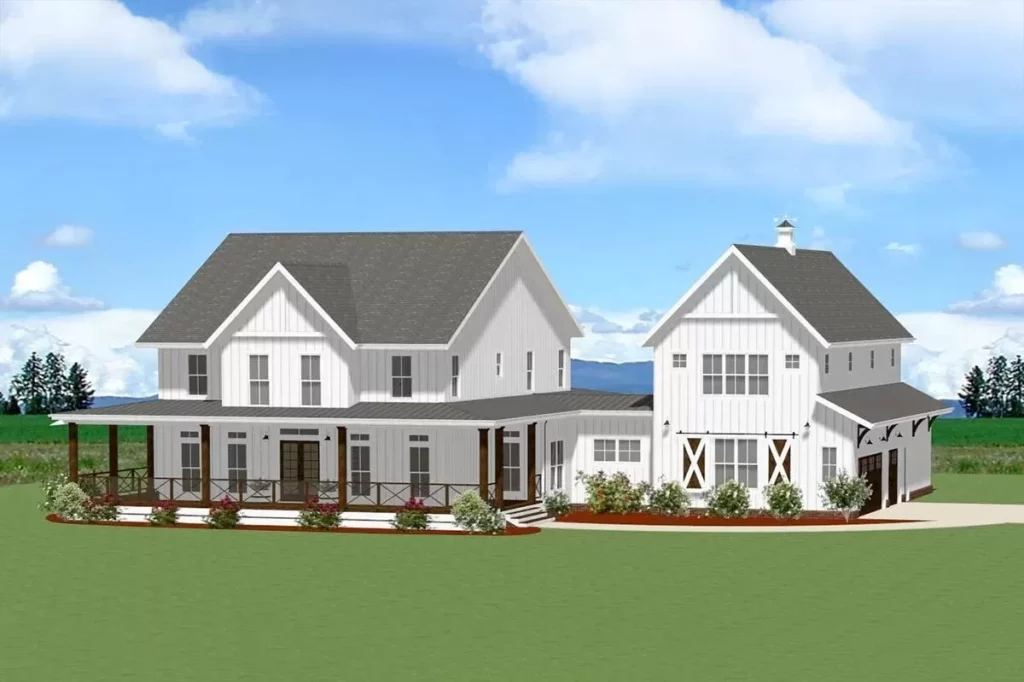
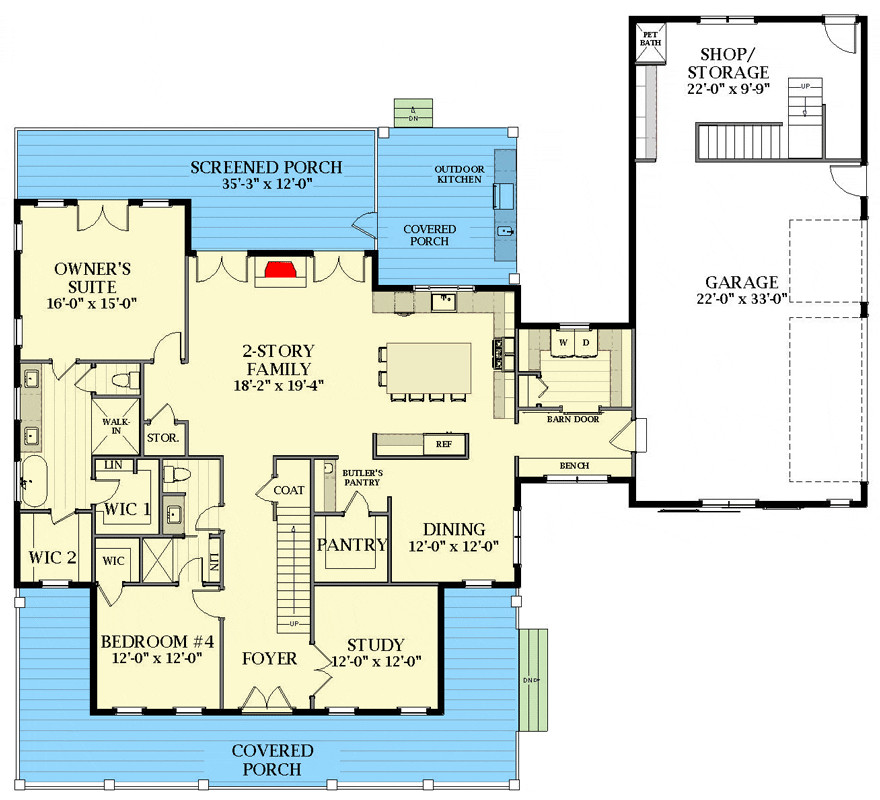
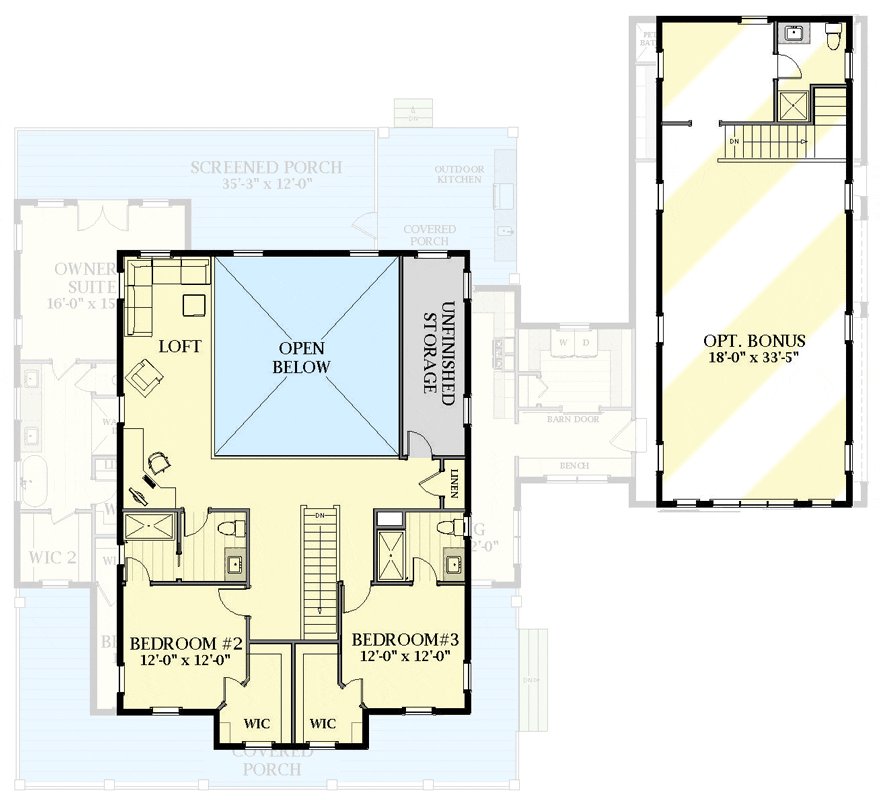
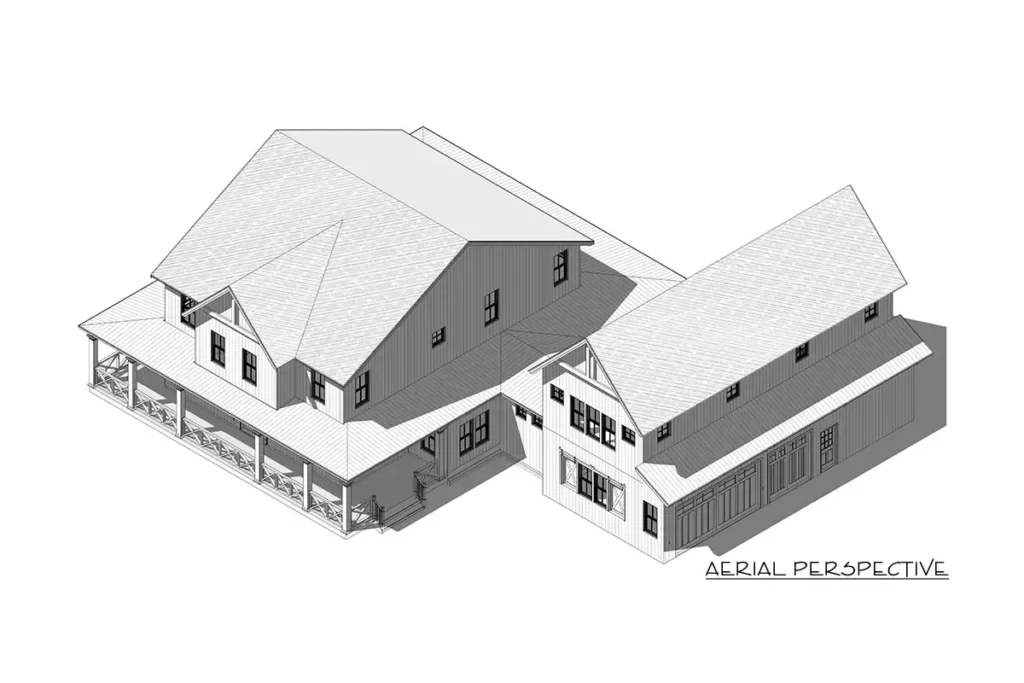
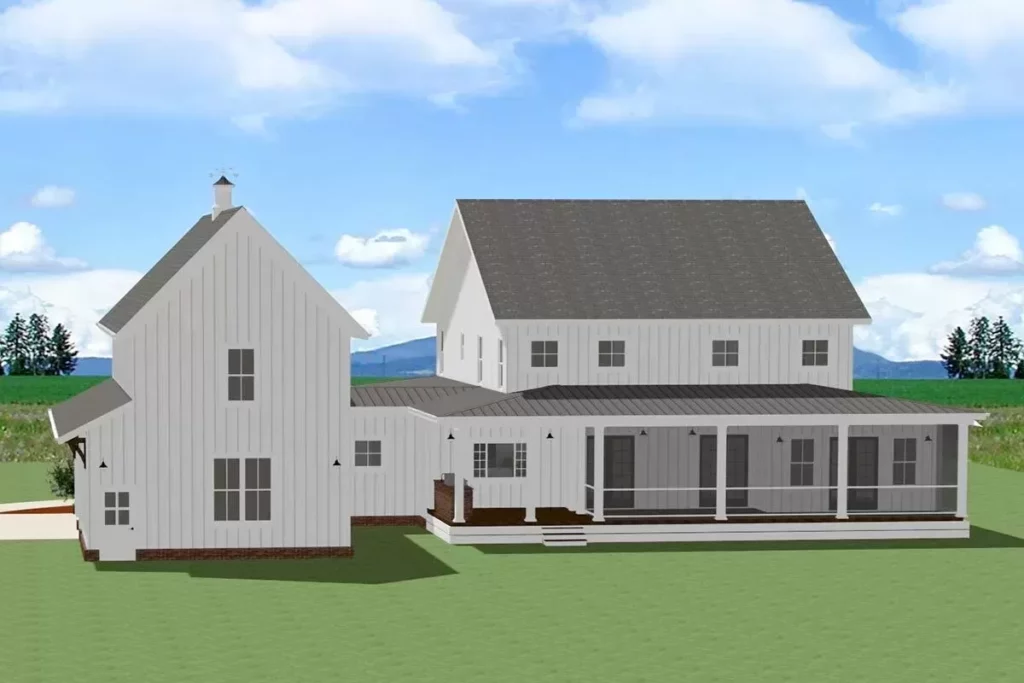
8.2 What is ICF Construction?
Insulated Concrete Forms are hollow blocks made of expanded polystyrene (EPS) foam. They stack like Legos, get filled with rebar and poured concrete, and create walls that are:
- Incredibly strong -- 6" of reinforced concrete core. Rated for 250+ mph winds (EF5 tornado).
- Super insulated -- R-25 to R-50 depending on form thickness. Heating/cooling costs are 40-60% less than stick-built.
- Quiet -- The mass of concrete blocks exterior noise.
- Fire resistant -- Concrete doesn't burn. 4-hour fire rating.
- Pest resistant -- No wood for termites to eat in the walls.
- Long-lasting -- 100+ year structural life.
8.3 ICF Build Process
Pre-Construction (4-6 weeks)
- Architectural plans -- Adapt the 3,400 sq ft, 4-bedroom 2-story country farmhouse plan for ICF construction. Include cold storage room adjacent to pantry, utility room, 2-story family room, screened porch, outdoor kitchen, and attached garage with shop.
- ICF engineering -- The ICF manufacturer or a structural engineer designs the rebar schedule and bracing plan for the concrete pour.
- Permits -- Building permit from Polk County. ICF is code-compliant but your builder should verify the local inspector is familiar with it.
- Site prep -- Final grade building pad, install erosion controls, dig utility trenches.
Foundation (2-3 weeks)
- If slab-on-grade: Excavate and compact, lay gravel base, install plumbing rough-in (drain lines, water supply), lay vapor barrier, place rebar/mesh, pour 4-6" reinforced concrete slab.
- If basement: Excavate 8-9 ft deep, pour footings, set ICF forms for basement walls (yes, ICF for basement too), pour walls, waterproof exterior, install French drain system around entire perimeter, lay drain tile to daylight or sump pit, backfill with gravel.
ICF Walls -- First Floor (2-3 weeks)
- Stack ICF forms on the foundation. Forms interlock. Window and door bucks are set in place.
- Place rebar vertically and horizontally per engineering specs.
- Brace walls with turnbuckle bracing to keep them plumb and straight during the pour.
- Pour concrete in 4-ft lifts. Do NOT pour the full height at once -- the pressure will blow out the forms. Use a concrete pump truck.
- Let cure 3-7 days minimum before removing bracing.
Second Floor System (1-2 weeks)
- Install floor system -- Engineered wood I-joists or steel bar joists bearing on the ICF walls. The forms have embedded ledger strips for attaching framing.
- Deck the floor with 3/4" plywood or OSB subfloor.
ICF Walls -- Second Floor (2-3 weeks)
- Repeat the ICF stacking, rebar, bracing, and pour process for the second story.
- Set window and door bucks at this level.
Roof (2-3 weeks)
- Conventional roof framing -- Trusses or rafters bearing on the top of the ICF walls. The top course of ICF gets a pressure-treated sill plate embedded in the concrete for attaching trusses.
- Metal roofing recommended for longevity, fire resistance, and rainwater collection potential.
- Insulation -- Blown-in or spray foam in the attic/roof cavity.
Mechanicals (3-4 weeks)
- Electrical -- ICF has foam on both sides. Wire runs are chased into the interior foam with a hot knife. Outlet and switch boxes embed in the foam. This is standard ICF practice.
- Plumbing -- Interior walls (framed conventionally) carry plumbing. Exterior ICF walls should not have plumbing in them.
- Heating/Cooling -- No traditional HVAC. Install cold-climate rated ductless mini-split heat pumps (3-4 indoor heads: main living area, owner's suite, upstairs zone, kitchen/dining). Spec Mitsubishi Hyper-Heat (H2i), Fujitsu XLTH, LG Red, or Carrier Arctic series -- these are rated to -13 to -22 degrees F and maintain 87%+ capacity at 5 degrees F. Standard mini-splits lose significant capacity below 15 degrees F -- do NOT install standard units. Cold-climate units cost 10-15% more but the cold-weather performance difference is massive. A 3,400 sq ft ICF house needs only 2-3 tons of capacity vs. 5-6 for stick-built. No ductwork to install, route, or maintain. Each zone is independently controlled. Budget: $10,000-18,000.
- Wood stove -- EPA-certified, high-efficiency (75%+) wood stove in the 2-story family room. Brands: Blaze King, Jotul, Vermont Castings. Co-primary heat source during the 15-20 coldest nights per winter (Dec-Feb) when temps drop below 10 degrees F. Even cold-climate mini-splits work harder at those temps -- fire up the wood stove instead and let the mini-splits rest. Your 14 acres of timber provides free fuel. A single wood stove heats the entire ICF home. Budget: $2,000-4,500 installed with chimney.
- Hot water -- Heat pump water heater (most efficient) or tankless propane.
Interior Finish (4-6 weeks)
- Interior walls are standard framing and drywall (not ICF). ICF is only for exterior walls.
- ICF interior surface gets drywall attached directly to the embedded furring strips in the foam.
- Flooring, cabinetry, fixtures -- standard residential finish work.
8.4 Cold Storage Room
A dedicated cold storage room inside the home for dairy products, meat, produce, and fermentation.
| Location | First floor, adjacent to kitchen or pantry. Ideally on a north-facing exterior wall. |
| Size | 6x8 ft or 8x8 ft (48-64 sq ft) |
| Walls | If on an exterior ICF wall, you already have R-25+ insulation. Add 2" rigid foam to interior partition walls and ceiling. |
| Floor | Sealed concrete or tile (easy to clean, handles condensation) |
| Cooling | CoolBot controller ($350) + standard window AC unit. Maintains 35-40°F. |
| Shelving | Stainless steel wire shelving (food-safe, allows air circulation) |
| Door | Insulated exterior-grade door with good gasket seal |
| Drain | Floor drain for condensation and cleaning |
8.5 ICF Food Storage Outbuilding (If No Basement)
If the geotech survey determines a basement is not feasible (high water table, rock shelf, etc.), build a dedicated ICF food storage outbuilding on Dave & Kami's parcel. This structure serves as the centralized long-term food storage for all three families.
| Construction | ICF walls and roof deck (poured concrete ceiling) -- same tornado-rated construction as the home |
| Size | 12x20 ft interior (240 sq ft) or 16x20 ft (320 sq ft) -- adjust based on storage needs |
| Foundation | Reinforced concrete slab with vapor barrier and perimeter drainage |
| Entrance | Steel security door, concealed or inconspicuous location. Consider earth-berming 2-3 sides for added insulation and concealment. |
| Climate Zones | Two zones: Cold room (35-40°F via CoolBot + AC) and root cellar / dry storage (50-55°F, passive cooling from earth berming) |
| Shelving | Stainless steel wire racks, floor-to-ceiling. 5-gallon bucket storage below, Mylar bag storage above. |
| Power | Dedicated 20A circuit from home panel. CoolBot + window AC draws ~1,200W. Battery backup recommended. |
| Security | Steel door with deadbolt, no windows, hidden location (bermed into hillside or behind tree line). Optional: motion sensor alarm tied to home security. |
| Ventilation | Small exhaust fan with intake vent (screened, baffled). Prevents moisture buildup in dry storage zone. |
| Cost | $30,000-60,000 depending on size and earth-berming scope |
Why ICF for the Outbuilding?
- Tornado-proof: Same EF4+ rated construction as the home. Your food supply survives even if outbuildings around it don't.
- Temperature stable: ICF + earth berming maintains 50-55°F year-round with zero energy input. Add CoolBot for the cold zone.
- Moisture resistant: Concrete doesn't rot, mold, or attract pests. Ideal for long-term food storage.
- Secure: Concrete walls, steel door, no windows, secluded location -- extremely difficult to break into.
- Fire resistant: 4-hour fire rating. Your food supply is protected even during a wildfire or structure fire.
- 100+ year lifespan: Build it once. It outlasts everything else on the property.
Recommended Layout (16x20 ft / 320 sq ft)
- Cold zone (8x16 ft): CoolBot-cooled, 35-40°F. Fresh dairy, eggs, produce, aging cheese, cured meats. Stainless wire shelving.
- Dry storage zone (12x16 ft): Earth-cooled, 50-55°F. 5-gallon buckets of grain, rice, beans, flour. Mylar-sealed freeze-dried foods. Canned goods. Root vegetables (potatoes, carrots, onions, garlic).
- Insulated partition wall between zones with weather-stripped door.
8.6 Solar & Energy System
| Array Size | 8-12 kW (20-30 panels) -- ICF home uses less energy, so you can size smaller |
| Battery | Tesla Powerwall, Enphase IQ, or similar. 10-20 kWh capacity for overnight/cloudy day coverage. |
| Inverter | Hybrid inverter (grid-tied with battery backup). Allows grid tie now, full off-grid later. |
| Backup Generator | Whole-home generator (propane or diesel), 12-20 kW, auto-transfer switch |
| Critical Loads | Cold storage, well pump, refrigerator, internet/comms, lighting |
| Mounting | Roof-mount (metal roof is ideal for solar mounting) or ground-mount array |
Start grid-tied with battery backup. This gives you immediate savings and backup power. Transition to full off-grid over time by adding battery capacity and reducing grid dependence.
8.7 Chicken Coop & Run
| Flock Size | 12-15 hens (layers) + seasonal meat birds (Cornish Cross or Freedom Rangers) |
| Coop Size | 8x10 ft minimum (4 sq ft per bird inside) |
| Run Size | 200-300 sq ft fenced run (10 sq ft per bird minimum) |
| Fencing | Hardware cloth (not chicken wire -- predator proof), buried 12" to stop diggers |
| Features | Nesting boxes (1 per 3-4 hens), roosts, ventilation, predator-proof door with auto-closer |
| Free Range | Open the run during the day for free-range access, lock up at dusk |
Layer breeds for Missouri: Rhode Island Red, Barred Rock, Buff Orpington (cold hardy, good producers, dual purpose).
Meat birds: Cornish Cross (8-week grow-out) or Freedom Rangers (10-12 weeks, better free-range). Process 25-50 per batch, 2-3 batches per year for a family.
Phase 3: Renn & Vanessa Setup
Concurrent with Phase 2 Duration: 4-6 weeks for trailer setup
9.1 Trailer Placement
- Site prep: Level pad, compacted gravel base, proper drainage grading away from trailer
- Utility hookups: 200-amp electrical panel (even for a trailer -- supports future home), water line with pressure pump, septic connection
- Septic: Install the permanent septic system now (not a temporary one). The trailer connects to it, and the permanent home will too. Saves money long-term.
- Skirting: Insulate and skirt the trailer for winter. Missouri winters will freeze exposed plumbing.
- Position the trailer so it doesn't sit on the future home's foundation footprint. Place it to one side of the lot.
9.2 Permanent Home Planning
Renn & Vanessa will design and build their permanent home after getting established. Options to discuss with them:
- Stick-built -- conventional framing, most builders available, fastest to build
- ICF -- same as Dave's, more expensive but superior performance
- Barndominium / metal building -- steel frame with finished interior, fast and durable, very popular in Missouri
- Post-frame -- pole barn construction with finished interior, cost-effective, fast
Propane, Equipment & Practical Needs
Propane Storage (Each Home)
| Tank Size | 500 gallon per home (sufficient -- no propane heating. Mini-splits + wood stove handle all heating.) |
| Placement | Minimum 10 ft from buildings, 10 ft from property lines, 10 ft from ignition sources |
| Uses | Backup generator, cooking (gas range), hot water (if propane tankless water heater instead of heat pump water heater) |
| Delivery | Propane delivery truck needs access -- place tanks near a driveway |
| Cost | Lease from propane company (free tank, you buy their propane) or buy your own ($1,500-2,500 for 500 gal) |
Equipment & Tractor
| Equipment | Purpose | Est. Cost (Used) |
|---|---|---|
| Compact tractor (25-40 HP) | Everything -- loader work, mowing, grading, hauling, post holes | $12,000-25,000 |
| Front-end loader (on tractor) | Moving hay bales, gravel, manure, dirt | Usually included with tractor |
| Box blade | Road/driveway grading and maintenance | $500-1,200 |
| Brush hog / rotary mower | Pasture mowing, clearing | $800-2,000 |
| Post hole digger (PTO) | Fence post holes -- you'll drill hundreds | $400-800 |
| 3-point carry-all / pallet forks | Moving materials, hay, supplies | $200-600 |
| Chain harrow / drag | Spreading manure in pastures, breaking up clumps | $300-800 |
| ATV / UTV (side-by-side) | Daily property rounds, hauling feed, checking fences | $3,000-8,000 |
| Chainsaw (18-20") | Tree removal, firewood, storm cleanup | $300-600 |
| Trailer (16-20 ft flatbed) | Hauling hay, supplies, equipment, livestock | $2,000-5,000 |
Buy the tractor before fencing. The post hole digger alone saves hundreds of hours. A used John Deere, Kubota, or New Holland compact tractor with low hours is the single best investment for a homestead this size.
Fuel Storage
- Location: Outdoor fuel cabinet or stand, away from all buildings (25+ ft). NOT in the shop.
- Gasoline: 2-3 five-gallon cans for ATV, chainsaws, small equipment. Rotate monthly.
- Diesel: If your tractor is diesel, a 100-gallon transfer tank on a stand with a hand pump. Treat with stabilizer in winter.
- Fire extinguisher: Keep an ABC extinguisher at the fuel station.
Mailbox & Address
- 911 address: Contact Polk County to get 911 addresses assigned to each parcel (once subdivided). This is required before you can get utilities, insurance, or emergency services.
- Mailbox: 3-bay cluster mailbox at the main road entrance. Mount on a 4x4 post. Position per USPS rural mailbox guidelines (41-45" height, 6-8" back from road edge).
- Property signage: Reflective address numbers on the mailbox post and at each driveway fork so emergency vehicles can find each home.
Waste Management
- Rural pickup: Check if Polk County has curbside service in your area. If not, you'll need a waste hauler (Republic Services, local company) or do dump runs.
- Transfer station: Locate the nearest Polk County transfer station / landfill for construction waste and large items.
- Composting: Organic waste (kitchen scraps, garden waste, manure) goes to the 3-bin compost system at the garden.
- Burn pile: Brush, cardboard, and untreated wood can be burned in rural MO. Check county burn regulations and notify the fire department when burning large piles.
- Recycling: May need to self-haul to a recycling center in Bolivar.
Construction Phase -- Temporary Facilities
- Temporary power: Ask your electrician to set up a temporary construction panel at the power pole. 100-amp temp service with a few 110V and 220V outlets. The utility will meter it. This powers tools, concrete mixers, etc.
- Portable toilet: Rent a porta-potty for the construction site. ~$75-150/month. Required by most builders for their crew.
- Material staging: Use the future shop area as the staging/delivery zone. Flatten and gravel it early so delivery trucks don't get stuck.
- Construction dumpster: 20-yard roll-off dumpster for construction waste. ~$300-500 per haul. Plan for 2-3 hauls during a full home build.
- Where to live: Consider placing a trailer on-site during construction (like Renn & Vanessa). Being on-site daily during a build saves time, catches problems early, and avoids rent costs. You could share or swap the trailer with Renn after your home is done.
Predator Management
| Predator | Targets | Defense |
|---|---|---|
| Coyotes | Sheep, chickens, calves | Woven wire fencing, hot wire on top, livestock guardian dog (Great Pyrenees) -- the most effective single measure |
| Hawks / Eagles | Chickens, small poultry | Covered runs, fishing line strung overhead in criss-cross pattern, guinea fowl (they alarm-call) |
| Raccoons / Possums | Chickens, eggs | Hardware cloth on coops (not chicken wire -- raccoons tear it), auto-closing door at dusk, secure latches (raccoons can open simple latches) |
| Foxes | Chickens | Buried wire (dig barrier), secure coop, guardian dog |
| Stray dogs | Sheep, chickens | Good perimeter fencing, guardian dog. Report to animal control. |
| Snakes | Eggs, chicks | Hardware cloth with 1/2" or smaller openings on coops. Keep grass mowed near buildings. |
Phase 4: Fencing & Pasture
Priority: Required before livestock Duration: 4-8 weeks
10.1 Perimeter Fencing
| Type | 5-strand barbed wire or high-tensile wire on T-posts with wooden corner/brace posts |
| Height | 48-54 inches for cattle |
| Posts | T-posts every 12-15 ft, 6" wooden posts at corners and gates |
| Corner Braces | H-brace or double-brace at every corner and gate -- this is what holds the whole fence together |
| Gates | 16 ft farm gates at driveway crossings, 4 ft walk-through gates for foot access |
10.2 Salatin-Style Rotational Grazing System
This system is modeled after Joel Salatin's Polyface Farm. The core idea: stack multiple enterprises on the same 12 acres in a timed relay -- cattle graze first, then chickens follow to spread manure and eat fly larvae, building soil fertility with every rotation cycle. This approach can produce 2-4x more per acre than conventional grazing.
The Math: Paddock Count for 45-60 Day Rest
Formula: (Rest days / Graze days) + 1 = Number of paddocks
| Graze Period | Paddocks Needed | Paddock Size | Rest Period | Notes |
|---|---|---|---|---|
| 1 day | 61 | ~0.2 acres | 60 days | Too many -- impractical at this scale |
| 2 days | 31 | ~0.4 acres | 60 days | Doable but lots of fence moves |
| 3 days | 16-21 | ~0.6-0.75 acres | 45-60 days | Sweet spot for your herd size and acreage |
| 5 days | 13 | ~0.9 acres | 60 days | Easier management, still good rest |
- 16 paddocks at ~0.75 acres each across your 12 grazing acres
- 3 days grazing per paddock with your herd (2 dairy + 2-4 beef)
- Rest period: 15 resting paddocks x 3 days = 45 days minimum rest
- Spring adjustment: When grass is exploding, graze 2 days/paddock = 30 x 2 = 60 days rest
- Summer adjustment: If grass slows, graze 4 days/paddock or pull cattle off and feed hay on a sacrifice area
- Never graze below 3-4 inches. You manage grass, not cattle. When it's gone, move them -- even if it's been less than 3 days.
The Lane System (Polyface Layout)
The simplest and most effective layout. A permanent central lane runs through the grazing area, with paddocks opening off both sides via drop-down electric wire gates.
How It Works
- Central lane: Permanent 12-16 ft corridor with electric wire on each side. Always open. Cattle walk this lane to reach any paddock. Water trough and mineral feeder stay in the lane -- you never move water.
- Paddock gates: Just unhook the polywire on one side to open a paddock. Cattle enter, graze 3 days, then you close it and open the next one.
- Lane connects to dairy barn: Morning and evening, dairy cows walk the lane to the milking parlor and back. Beef cattle stay in the paddock.
- Eggmobile follows: 3-4 days after cattle leave a paddock, move the eggmobile in. Hens scratch through cow patties, eat fly larvae, spread manure, and add nitrogen. (See Section 12.5)
- Broiler pens run separately: Salatin-style 10x12 ft pens on other paddocks or along the lane edges. Moved daily. (See Section 12.6)
Fencing Components
| Component | Details | Cost |
|---|---|---|
| Permanent lane fences | 2 parallel runs of high-tensile electric wire + T-posts, ~800-1,200 ft total | $300-600 |
| Portable paddock dividers | Polywire + step-in posts. Only need 2-3 reels to create paddock boundaries off the lane | $150-300 |
| Solar fence charger | 1-2 joule unit powers the entire system (lane + paddocks + perimeter) | $150-300 |
| Water system and shade: see Sections 10.3 and 10.4 (budgeted separately) | ||
| Fencing-Only Total | $600-1,200 | |
Seasonal Grazing Calendar
| Season | Graze Days/Paddock | Rest Period | Strategy |
|---|---|---|---|
| Spring (Apr-May) | 2 days | ~60 days | Grass is exploding. Short graze, long rest. Surplus paddocks can be cut for hay. |
| Summer (Jun-Aug) | 3-4 days | ~45-60 days | Growth slows in heat. May need to feed hay supplement. Graze early morning/evening. |
| Fall (Sep-Oct) | 2-3 days | ~45-60 days | Second growth flush. Stockpile 4-6 paddocks -- let them grow tall for late fall/winter grazing. |
| Late Fall (Nov-Dec) | 3-5 days | N/A (stockpiled) | Graze the stockpiled paddocks. Extends grazing 4-6 weeks, saving hay. |
| Winter (Jan-Mar) | N/A | Full rest | Feed hay in a sacrifice area or heavy-use pad near the barn. All paddocks resting. |
Daily Routine (15-20 Minutes)
- Check cattle in current paddock -- head count, health check, water level
- Every 3 days: Open next paddock gate (unhook polywire), close current paddock
- Move eggmobile to the paddock cattle left 3-4 days ago (every 3-4 days, 10 min)
- Move broiler pens to fresh grass (daily, 5 min per pen)
- Read the grass: If a paddock is grazed below 3-4 inches before the 3 days are up, move cattle early. If grass is still tall after 3 days, you can leave them an extra day.
You are managing grass, not cattle. The animals are tools for converting sunlight (via grass) into fertility, food, and income. Every management decision should ask: "Does this build soil?" The rest period is what grows the grass. The grazing is what stimulates new growth. The chicken follow-up is what spreads fertility evenly. It's a system -- each part feeds the next.
Your 2 acres of dedicated hay ground will supplement -- but not fully supply -- winter feed.
| Detail | Value |
|---|---|
| Yield per cutting | ~2-4 tons (depends on soil fertility, moisture, grass species) |
| Cuttings per year | 2 (late May/early June + late July/August in Missouri) |
| Annual production | 4-8 tons |
| Winter hay need | ~12-15 tons (for 2 dairy + 2 beef + sheep if applicable) |
| Gap to purchase | ~7-10 tons/year @ $40-80/round bale = $800-1,600/winter |
Strategies to Reduce Purchased Hay
- Stockpile paddocks: In fall, let 4-6 paddocks grow tall (no grazing). Graze these through Nov-Dec. This saves 4-6 weeks of hay -- roughly 3-4 tons.
- Sell beef in fall: Process beef cattle before winter. Overwinter only the 2 dairy cows + a few sheep. Cuts hay need nearly in half.
- Baleage: Wrap your hay bales wet (baleage). Ferments like silage -- higher nutrition per bale, and you can cut earlier / in wetter weather.
- Improve pasture: Over-seed with high-yield grasses (orchard grass, red clover) and manage fertility. Better grass = more grazing days = less hay.
10.3 Livestock Water System
Water stays in the lane -- you never move it to individual paddocks. This is the single biggest labor-saver in rotational grazing. Cattle walk to the lane to drink, then return to graze.
Daily Water Requirements
| Animal | Gallons/Day (Summer) | Gallons/Day (Winter) | Notes |
|---|---|---|---|
| Dairy cow (lactating) | 25-35 | 15-20 | Highest demand. Production drops if water is restricted. |
| Beef cow/steer | 15-20 | 8-12 | Hot days push toward 20+. Calves drink less. |
| Sheep (adult) | 2-3 | 1-2 | Sheep get some moisture from grass but still need fresh water daily. |
| Chickens (per 30 birds) | 3-5 | 2-3 | Eggmobile and broiler pens have their own small waterers. |
| Your herd total (est.) | 80-115 gal/day | 45-60 gal/day | Based on 2 dairy + 2 beef + 12 sheep + 30 chickens |
Water System Components
| Component | Specification | Cost |
|---|---|---|
| Supply line from well | 3/4" or 1" HDPE pipe, buried 3 ft below frost line (36" in SW Missouri). Run along the driveway trunk line, branch south to the lane. | $400-800 |
| Frost-free hydrant | Merrill C-1000 or equivalent, 4-5 ft bury depth. Install in center of lane. Drains below frost line when shut off -- no freeze risk. | $150-250 |
| Stock trough (portable) | Rubbermaid 100-gal or Behlen 100-gal on skids. Float valve auto-fills from hydrant via garden hose. Drag with ATV when repositioning. | $100-200 |
| Float valve assembly | Brass float valve ($15-25) inside trough. Maintains constant water level. No daily filling needed. | $15-25 |
| Heated base (winter) | Allied Precision or Farm Innovators tank de-icer, thermostatically controlled. Plugs into 120V -- run an outdoor-rated extension cord from dairy barn or install an outlet on a post in the lane. | $50-100 |
| Backup: portable tank | 275-gal IBC tote on a trailer. Fill at the barn and haul to the lane if main line freezes or needs repair. Gravity feeds into trough. | $75-150 (used) |
| Water System Total | $790-1,525 |
How It Works With the Paddocks
- Hydrant is permanently in the lane. Trough sits next to it. Cattle in any paddock can walk through the open lane gate, drink, and return to graze. They learn the route within 2-3 days.
- Float valve keeps trough full. You never haul water. Check the trough once daily during your morning routine -- confirm it's filling and clean.
- In summer, you may add a second trough at the far end of the lane if paddocks P11-P16 are a long walk. A garden hose from a second hydrant or a gravity-feed IBC tote works.
- In winter, plug in the heated base. The de-icer keeps water at 40-50 degrees F -- cattle actually drink more when water isn't ice-cold, reducing hay consumption.
- Sheep get their own water in the sheep field (separate frost-free hydrant + heated trough). They don't share the cattle lane.
- Chickens: Eggmobile has a 5-gal gravity waterer refilled every 2-3 days. Broiler pens have bell waterers filled daily from a 5-gal bucket.
In Missouri, you'll get stretches of single-digit temps in January/February. If your water freezes, cattle go without -- and a lactating dairy cow that misses water for 12 hours drops production for a week. The frost-free hydrant + heated trough eliminates this. Budget $50-100 for the de-icer and make sure you have 120V power accessible in the lane (a buried line from the dairy barn is ideal). This is not optional.
10.4 Shelter & Shade for the Rotational System
Cattle need protection from three things: winter wind/ice, summer heat, and rain storms. In a Salatin-style lane system, shelter goes in or adjacent to the lane -- not in individual paddocks.
Run-In Shed (Primary Shelter)
| Detail | Specification |
|---|---|
| Type | 3-sided pole barn, open on south/southeast side (prevailing winter wind in SW Missouri comes from the NW) |
| Size | 12x24 ft minimum for 4 cattle (60-80 sq ft per animal). Build 16x24 if budget allows. |
| Location | Inside the central lane, near the midpoint. Cattle from any paddock can walk the lane to reach it. Place it near the water trough -- cattle naturally loaf where water is. |
| Roof | Metal, single-slope, pitched away from open side. Minimum 8 ft at open side, 6 ft at back wall. Overhang 2 ft on open side for rain protection. |
| Floor | 6" compacted gravel base. Add straw bedding in winter (deep bedding method -- add fresh straw on top, clean out in spring). Concrete is not needed and cattle prefer standing on earth/straw. |
| Back wall | Solid -- blocks NW wind. Treat posts with ground-contact rated preservative or use 6x6 treated posts set 3 ft deep in concrete. |
| Side walls | Solid on the NW side, open or partial on the SE side for airflow in summer. |
| Calving pen | Attach a 10x10 ft enclosed pen with a swing gate on one end. Use during birthing season (Feb-Apr) so you can isolate a cow and calf for 24-48 hours. |
| Cost | $2,000-5,000 (pole construction, metal roof, treated lumber) |
If you put the run-in shed inside a paddock, cattle congregate there and destroy the grass in a 50-ft radius around it. In the lane, the heavy-traffic damage stays on a non-grazing surface. The lane is already a sacrifice area (compacted path) -- the shed just extends it. Cattle graze in the paddocks and loaf in the lane. This separation is what keeps your pasture healthy.
Summer Shade Options
Missouri summers hit 95-100 degrees F with high humidity. Cattle under heat stress eat less, gain less, and dairy cows drop milk production 10-25%. Shade is not a luxury.
| Option | Details | Cost |
|---|---|---|
| Natural tree shade | If paddocks border timber, cattle will self-shade. Open the lane gate to a wooded paddock during the hottest hours (noon-4pm). Best and free option. | $0 |
| Portable shade structure | 10x10 or 10x20 ft metal roof on 4 posts, mounted on skids. Drag with ATV to whichever paddock the cattle are in. One structure covers 4-6 head. | $200-500 |
| Shade cloth canopy | 80% shade cloth stretched over T-post frame. Cheap and effective. Won't survive strong wind -- take it down before storms. | $50-150 |
| Run-in shed (in lane) | Cattle will use the run-in shed for summer shade too. The open south side provides airflow. This may be sufficient if the walk from far paddocks isn't too long (<1/4 mile). | Already built |
Seasonal Shelter Strategy
| Season | Primary Shelter | Notes |
|---|---|---|
| Winter (Dec-Feb) | Run-in shed in lane + deep straw bedding | Cattle are surprisingly cold-hardy with a dry wind break. They don't need a fully enclosed barn. Keep bedding dry -- wet bedding + cold = problems. |
| Calving (Feb-Apr) | Calving pen attached to run-in shed | Check heifers/cows every 4-6 hours during calving season. Isolate cow + calf for 24-48 hours to bond. |
| Spring/Fall | Run-in shed available, mostly unused | Cattle prefer to be outside. They'll use the shed during heavy rain. |
| Summer (Jun-Aug) | Natural shade or portable shade in active paddock | Move cattle to morning paddocks near trees. Provide shade in open paddocks during heat advisory days (105+ heat index). |
What About the Eggmobile and Broiler Pens?
- Eggmobile: It IS the shelter. The hens roost inside it at night and range out during the day. It moves with them through the paddocks -- no separate coop needed.
- Broiler pens: The Salatin pen design (10x12x2 ft, half covered) provides shade and rain protection. The open wire half gives ventilation. Move daily to fresh grass. In extreme heat (100+ degrees F), prop one end up 4-6 inches for extra airflow.
In January-March when all paddocks are resting, cattle live in a "sacrifice area" -- a section of lane near the barn and run-in shed that you intentionally let get torn up. Feed hay here on a heavy-use pad (6" of compacted gravel or old concrete). This concentrates manure in one spot (compost it in spring) and keeps your recovering paddocks pristine. Budget 2,000-4,000 sq ft for the sacrifice area. It's ugly in March but the paddocks thank you by May.
10.5 Sheep/Livestock Field Fencing
| Type | Woven wire (no-climb) 4 ft high with a strand of electric wire at the top |
| Why different | Sheep can slip through barbed wire. Woven wire keeps them contained and keeps predators out. |
| Predator protection | Top electric wire deters coyotes climbing/jumping. Consider a livestock guardian dog (Great Pyrenees). |
10.6 Garden Fencing
| Perimeter | ~7,775 sq ft production garden |
| Fence Height | 8 ft (deer can jump 6 ft easily) |
| Type | Welded wire or woven wire on wooden posts |
| Dig Barrier | Hardware cloth or welded wire buried 12-18" below ground level, bent outward in an L-shape. Stops rabbits, groundhogs, and armadillos from digging under. |
| Electric Option | 2 strands of electric wire -- one at 6" (nose height for deer approaching) and one at 30". Solar charger. |
| Gate | Wide enough for a wheelbarrow or small tractor (8-10 ft) |
10.7 Pasture Preparation
- Soil test the grazing areas -- may need lime and fertilizer to optimize grass growth
- Overseed if needed -- Fescue, clover, and orchard grass mix is standard for Missouri pastures
- Mow and manage -- Mow the grazing paddocks to 8-10" before introducing cattle. This stimulates growth.
- Hay fields -- fertilize based on soil test, mow first cutting at boot stage (late May/early June in Missouri), second cutting 6-8 weeks later
Phase 5: Agricultural Buildings
Priority: Required before livestock Duration: 8-16 weeks
11.1 Dairy Barn -- Milking & Processing
A single building with two zones separated by a wall. Located near the well and power pole for easy utility access.
Building Specs
| Total Size | 24x24 ft to 24x32 ft (576-768 sq ft) |
| Construction | Pole barn / post-frame with metal siding and roof |
| Floor | Poured concrete throughout with floor drains (sloped to drain) |
| Utilities | Electric (lights, refrigeration, water heater), hot and cold water, drain |
Milking Side (~1/3 of building)
- 1-2 milking stanchions (head locks that hold the cow while milking)
- Wash station for cleaning udders before milking
- Floor drain for wash water
- Hose bib for cleanup
- Storage for milking supplies (teat dip, towels, filters)
- Feed trough at stanchion (cows eat while being milked -- keeps them happy and still)
Processing Side (~2/3 of building)
- Stainless steel work counter (8-10 ft, food-grade)
- Deep stainless sink (3-compartment: wash, rinse, sanitize) with hot water
- Tankless or small tank water heater
- Refrigerator / chest freezer for milk cooling
- Cheese aging closet (insulated, temperature controlled, 50-55°F, 80-85% humidity)
- Shelving for supplies and equipment
- Screened/sealed to keep flies out (screen doors, sealed gaps)
- Good lighting (LED shop lights)
Dairy Equipment Needed
| Item | Purpose | Est. Cost |
|---|---|---|
| Milking machine (portable) | Milks 1-2 cows efficiently | $300-800 |
| Milk pail (stainless) | Collection | $50-100 |
| Milk filters | Straining | $20/100 filters |
| Cream separator | Separates cream from milk | $200-500 |
| Butter churn | Butter production | $50-200 |
| Cheese press | Hard cheese making | $100-300 |
| Cheese molds | Shaping | $30-80 |
| pH meter / test strips | Monitoring fermentation | $20-50 |
| Thermometer (dairy) | Temperature control | $15-30 |
| Yogurt maker or Instant Pot | Yogurt/kefir | $30-100 |
| Wax or vacuum sealer | Cheese aging/storage | $50-100 |
Dairy Products You Can Make
| Product | Difficulty | Equipment | Time |
|---|---|---|---|
| Raw milk | Easy | Filter, jar | Minutes |
| Cream / Half & Half | Easy | Separator | Minutes |
| Butter | Easy | Churn or stand mixer | 20-30 min |
| Buttermilk | Easy | Byproduct of butter | Free |
| Yogurt | Easy | Pot, thermometer, culture | 8-12 hrs |
| Kefir | Easy | Kefir grains, jar | 24 hrs |
| Mozzarella | Medium | Pot, rennet, citric acid | 30-45 min |
| Ricotta | Easy | Pot, acid (vinegar/lemon) | 30 min |
| Cheddar | Advanced | Press, molds, cave | Months to age |
| Gouda | Advanced | Press, wax, cave | Months to age |
| Ice cream | Easy | Ice cream maker | 30-60 min |
| Ghee | Easy | Pot | 30-45 min |
11.2 Hay Storage
| Type | Pole barn roof, open sides (3-sided is fine for hay) |
| Size | 20x30 ft minimum -- holds ~30 round bales or 200+ square bales |
| Location | Central grazing area (as mapped), accessible by truck for delivery |
| Floor | Gravel base -- keeps hay off the dirt (wet hay = mold = fire risk) |
| Roof | Metal -- sheds water and lasts decades |
11.3 Wind Break / Run-In Shed
| Type | 3-sided pole structure, open on south/southeast side (blocks NW winter wind) |
| Size | 12x24 ft minimum for 4 cows (60-80 sq ft per animal). 16x24 if budget allows. |
| Location | Inside the central lane near the water trough (see Section 10.4). Cattle walk the lane from any paddock to reach shelter. Keeps heavy-traffic damage off pasture. |
| Roof | Metal, single-slope, pitched away from open side. 8 ft at front, 6 ft at back. 2 ft overhang. |
| Floor | 6" compacted gravel base. Deep straw bedding in winter -- add fresh straw on top, clean out in spring. |
| Calving pen | 10x10 ft enclosed pen with swing gate on one end for birthing season (Feb-Apr) |
| Winter sacrifice area | 2,000-4,000 sq ft of compacted gravel/lane surface near the shed for winter hay feeding when paddocks are resting |
See Section 10.4 for full shelter strategy, portable shade options, and seasonal shelter plan integrated with the rotational paddock system.
11.4 Sheep Shelter
| Type | 3-sided pole structure |
| Size | 10x16 ft for 10-12 sheep (12-16 sq ft per animal) |
| Location | Sheep field (as mapped) |
| Features | Enclosed lambing area (8x8) with gate for birthing ewes |
11.5 The Shop
| Zone Size | ~7,775 sq ft |
| Construction | Post-frame / pole barn with metal siding and roof |
| Floor | Poured concrete (4-6" reinforced, power-troweled smooth) |
| Doors | 2 overhead doors (12x12 or 14x14) for equipment, 1 walk-in door |
| Loft | Second-floor storage loft (3/4 of building or full mezzanine) |
| Electrical | 200-amp panel, 220V outlets for welders/compressors, LED shop lighting |
Zone Layout
- Woodworking area -- Dedicated space with dust collection system, workbench, tool wall. Keep sawdust separated from other areas.
- Equipment storage -- Tractor, implements, mower, ATV. Drive-through access is ideal.
- General workshop -- Welding area, metal work, repair station.
- Loft storage -- Seasonal items, supplies, building materials.
Concrete apron: Pour a 20x30 ft concrete pad in front of the shop for outdoor work, equipment parking, and delivery staging.
Phase 6: Livestock Operations
Priority: After fencing and buildings Duration: Ongoing
- All perimeter fencing + lane system + paddocks installed and tested
- Water system operational (frost-free hydrant in lane, float valve trough, heated base for winter)
- Run-in shed built in lane with calving pen + winter sacrifice area prepared
- Dairy barn operational (milking side at minimum)
- Hay supply secured (either from your fields or purchased)
- Mineral feeders and salt blocks in place
- Veterinarian identified (large animal vet with cattle experience)
12.1 A2 Dairy Cows
| Count | 2 cows |
| Breeds | Jersey (most popular A2, rich milk, smaller frame) or Guernsey (golden milk, gentle temperament) |
| Verify A2/A2 | Request genetic test results (A2/A2 beta-casein genotype). Do NOT assume -- test before buying. |
| Source | Buy from a registered A2 dairy. Missouri has several small A2 breeders. |
| Age | Buy a cow that's already been milked (proven milker), not a first-calf heifer, for your first cow. Easier to learn on. |
| Cost | $1,500-3,500 per cow for a quality A2 proven milker |
Daily Milking Routine
- Morning (5-6 AM): Bring cows to milking stanchion. Feed grain while milking.
- Clean udder with warm water and teat dip.
- Milk (15-20 min per cow by hand, 5-8 min with machine).
- Filter milk through disposable dairy filter into clean stainless pail.
- Cool immediately -- ice water bath or refrigerator within 30 minutes.
- Clean all equipment with dairy sanitizer.
- Evening (5-6 PM): Repeat. Dairy cows are milked twice daily, 12 hours apart.
Breeding & Calving Plan (Critical -- No Calf = No Milk)
A cow only produces milk after giving birth. She milks for ~10 months, then needs ~2 months dry before her next calf. You must breed your cows to keep them in milk.
| Breeding Method | Artificial Insemination (AI) -- most small dairies use this. No need to keep a bull (expensive, dangerous, eats a lot). Find an AI technician near Bolivar, MO. Your vet may also provide AI services. |
| Heat Detection | Watch for standing heat (cow stands still when mounted by another cow). Lasts 12-18 hours. Breed 12 hours after first standing heat. |
| Gestation | ~283 days (9.5 months) |
| Stagger Breeding | Breed Cow #1 and Cow #2 six months apart so one is always in peak milk while the other is dry. This ensures year-round milk supply. |
| Calving | Target late winter/early spring calving (Feb-Mar) for best pasture timing. Have the enclosed calving area ready. Keep calving supplies on hand (OB chains, iodine, towels, calf puller as emergency backup). |
| Colostrum | Calf MUST receive colostrum (first milk) within 6 hours of birth. This is non-negotiable for calf survival. |
| Calf Management | Heifer calves: keep as dairy replacements or sell. Bull calves: raise for beef (your beef supply) or sell as bottle calves. |
| Semen Selection | Choose A2/A2 tested semen from an AI catalog to maintain your A2 herd genetics. Jersey and Guernsey semen is widely available. |
Annual Dairy Calendar
| Month | Cow #1 | Cow #2 |
|---|---|---|
| Jan | Late lactation, dry off end of month | Peak milk production |
| Feb | Dry period | High production |
| Mar | Calving! Begin milking again | Mid lactation |
| Apr-Jun | Peak milk on fresh pasture | Breed Cow #2 (May/June) |
| Jul-Aug | High production, breed Cow #1 | Mid-late lactation |
| Sep | Mid lactation | Late lactation, dry off |
| Oct | Mid lactation | Dry period |
| Nov | Steady production | Calving! Begin milking again |
| Dec | Late lactation | Peak production |
With staggered calving, you always have at least one cow in milk. During overlap months, you'll have surplus -- that's when you make cheese and freeze-dry.
Veterinary & Health Schedule
| When | Task |
|---|---|
| Pre-purchase | Vet check, pregnancy test, A2/A2 genotype verification, brucellosis/TB test |
| Annually | Vaccination (IBR, BVD, Lepto, Blackleg), deworming, hoof trim |
| Pre-calving (2 wk) | Booster vaccines, move to calving area, watch for signs of labor |
| Post-calving | Monitor for retained placenta, milk fever (calcium deficiency), and mastitis |
| Monthly | Body condition scoring, hoof check, udder health check |
| At breeding | Confirm heat, AI appointment, pregnancy check at 30-45 days |
Emergency Supplies to Keep On Hand
- Calcium gluconate (for milk fever -- common in high-producing Jerseys)
- Iodine (navel dip for newborn calves)
- Mastitis test strips and treatment tubes
- OB chains and handles (calving assistance)
- Bloat treatment (mineral oil or Therabloat)
- Thermometer (normal cattle temp: 101-102.5°F)
- Vet's emergency phone number posted in the dairy barn
12.2 Beef Cattle
| Count | 1-2 head |
| Breeds | Angus, Hereford, or Red Devon (all do well in Missouri, good temperament) |
| Strategy | Buy weaned calves (6-8 months old), raise for 12-18 months, process |
| Processing | Use a USDA-inspected mobile butcher or take to a local processor |
| Yield | One beef cow yields ~400-500 lbs of meat. That's enough for 3 families for a year. |
| Cost | Weaned calf: $800-1,500. Processing: $800-1,200. Total: ~$2-3/lb for premium grass-fed beef. |
Grass-fed timeline: Buy calves in spring. Graze all summer and fall. Supplement with hay in winter. Process the following fall at 18-24 months. Repeat annually.
12.3 Sheep (Optional)
| Count | 10-12 ewes + 1 ram |
| Best Breeds | Katahdin or Dorper (hair sheep -- no shearing needed, low maintenance) |
| Purpose | Meat (lamb), pasture management, potentially wool if you go with wool breeds |
| Lambing | Once per year, typically late winter/early spring. Ewes usually have twins. |
| Predators | Coyotes are the #1 threat. Good fencing + a livestock guardian dog is the best defense. |
If you decide not to do sheep, the sheep field and shelter can be used for additional beef cattle, goats, pigs, or left as additional hay/pasture.
12.4 Annual Feed Requirements
| Animal | Count | Hay per Winter | Grain/Supplement |
|---|---|---|---|
| A2 Dairy Cows | 2 | ~6 tons | Dairy grain at milking (2-4 lbs/milking) |
| Beef Cattle | 2 | ~6 tons | Mineral block only (grass-fed) |
| Sheep | 12 | ~3 tons | Mineral block, grain for ewes at lambing |
| Chickens | 30-40 | N/A | Layer feed + scratch grain (~150 lbs/month total) |
| TOTAL HAY | ~15 tons/winter |
Your 2.54 acres of hay fields will produce ~5-8 tons per year (2 cuttings). You'll need to purchase ~7-10 tons annually. Budget ~$800-1,200/year at Missouri hay prices.
12.5 Eggmobile -- Laying Hens Follow Cattle (Salatin Method)
The eggmobile is the heart of the Salatin stacked enterprise system. It follows the cattle through the lane system on a 3-4 day delay, turning cow manure into fertility, pest control, and eggs.
| Detail | Specification |
|---|---|
| Structure | Mobile coop on a trailer frame or skids (8x12 ft or 8x16 ft). Tow with ATV/tractor. |
| Capacity | 30-50 laying hens (start with 30, scale to 50 as you learn the system) |
| Nesting boxes | 6-10 boxes inside (1 per 4-5 hens). Accessible from outside for egg collection. |
| Roosts | Interior roost bars for nighttime. Hens lock in at dusk for predator protection. |
| Floor | Wire mesh or slatted floor -- droppings fall through directly onto the pasture |
| Movement | Every 3-4 days, tow to the paddock that cattle left 3-4 days ago |
| Cost to build | $1,500-3,500 (lumber, roofing, hardware cloth, trailer frame or skids) |
| Egg production | 30 hens = ~20-25 eggs/day (peak season). 50 hens = ~35-40 eggs/day. |
How It Works in the Rotation
- Day 1-3: Cattle graze paddock, leaving behind manure patties
- Day 4-6: Fly larvae hatch and grow fat in the cow patties (this is the key timing)
- Day 4-7: Eggmobile arrives. Hens eagerly scratch apart every cow patty, eating the larvae (free high-protein feed!), spreading the manure evenly across the paddock, and depositing their own nitrogen-rich fertilizer
- Result: No fly problem (larvae eaten), manure spread evenly (no drag harrow needed), double fertilizer application (cow + chicken), and a basket of eggs every morning
Without the eggmobile, you'd need to drag the pasture with a chain harrow to spread cow patties (fuel, time, equipment). The hens do it for free AND give you eggs AND eat the fly larvae that would otherwise torment your cattle. One enterprise solves three problems. This is what Salatin means by "stacking."
12.6 Broiler Pens -- Pastured Meat Chickens (Salatin Method)
Floorless, bottomless pens that sit directly on the grass. Moved to fresh pasture every single day. The birds eat grass and bugs, fertilize the ground, and grow fast on a combination of pasture + supplemental feed.
| Detail | Specification |
|---|---|
| Pen size | 10 ft x 12 ft x 2 ft tall (the classic "Salatin pen") |
| Construction | Lightweight aluminum or wood frame, chicken wire sides, corrugated roofing (half covered for shade/rain, half open wire for ventilation) |
| Birds per pen | 60-75 Cornish Cross broilers |
| Movement | Move the entire pen 1 pen-length forward every morning (takes 5 min per pen with a dolly or hand-pull) |
| Feed | Broiler feed in trough feeders inside the pen + whatever they forage from the pasture (~20-30% of diet from grass/bugs) |
| Water | Bell waterers or nipple waterers inside the pen. Refill daily. |
| Grow-out time | 8 weeks from chick to processing (Cornish Cross). Receive as day-old chicks, brood 3 weeks indoors, then 5 weeks on pasture in the pens. |
| Cost per pen | $150-300 to build |
| Batches per year | 2-3 batches (May-Jun, Jul-Aug, Sep-Oct). Missouri season allows 3 if you start early. |
Year 1 Starter Plan
| Item | Details | Cost |
|---|---|---|
| Build 1-2 pens | 10x12 ft Salatin-style | $150-300 each |
| 50-75 Cornish Cross chicks | Order from McMurray Hatchery or Hoover's | $75-150 |
| Brooder setup (3 weeks) | Heat lamp, waterer, feeder, pine shavings. Garage or barn corner. | $50-100 |
| Broiler feed (per batch) | ~500-750 lbs for 50-75 birds over 8 weeks | $150-250 |
| Processing equipment | Kill cones, scalder, plucker (or use poultry processing station -- see Section 21) | Already budgeted |
| Year 1 Total (1 batch) | $425-800 |
Revenue Potential
- 50 birds processed: Average 4-5 lbs dressed weight = 200-250 lbs of pastured chicken
- Family consumption: ~150 lbs/year for 3 families, surplus to sell
- Market price: $5-7/lb or $20-30/whole bird at farmers market
- At scale (200 birds/year): $4,000-6,000 revenue from pastured chicken alone
Under Missouri's producer exemption, you can process up to 1,000 birds per year on-farm and sell directly to consumers without USDA inspection. Birds must be sold whole (not cut up), labeled "Exempt P.L. 90-492," and sold directly from the farm or at a farmers market. This exemption makes small-scale pastured poultry viable without the cost of USDA processing. See Section 21 for processing station details.
12.7 The Stacked Enterprise System -- Putting It All Together
This is the complete Salatin-style system running on your grazing acres:
The Relay Sequence
| Day | Paddock Activity | What's Happening |
|---|---|---|
| Days 1-3 | Cattle grazing | Cows eat grass down to 3-4 inches, deposit manure, trample seed into soil |
| Days 4-6 | Resting (no animals) | Fly larvae hatch and grow in cow patties. Grass starts to recover. |
| Days 7-10 | Eggmobile arrives | Hens demolish cow patties, eat larvae, spread manure, add chicken fertilizer, produce eggs |
| Days 11-60+ | Full rest | Double-fertilized pasture regenerates. Grass grows back thicker and healthier than before. |
Meanwhile, on Other Paddocks...
- Broiler pens run on 2-3 resting paddocks simultaneously (moved daily within the paddock, then to a new paddock when they've covered it)
- Every paddock gets: cattle grazing + eggmobile sanitation + rest period, creating a continuous improvement cycle
- Each pass builds soil: After 2-3 years of this rotation, your pasture will be dramatically more productive than when you started
Stocking Summary for 12 Acres
| Enterprise | Count | Infrastructure | Products |
|---|---|---|---|
| Dairy cows | 2 A2 cows | Lane system + 16 paddocks | Milk, cream, butter, cheese, yogurt |
| Beef cattle | 2-4 head (spring-fall) | Same paddocks as dairy | 400-1,000 lbs beef/year |
| Laying hens | 30-50 in eggmobile | Eggmobile on trailer | 7,000-12,000 eggs/year + pest control |
| Meat chickens | 150-200/year in broiler pens | 2-3 Salatin pens | 600-1,000 lbs chicken/year |
| Sheep (optional) | 10-12 ewes + ram | Separate 2-acre field | Lamb + pasture management |
- Year 1: Laying hens in eggmobile (30 birds) + 1 batch of 50-75 broilers in Salatin pens. Learn the daily-move rhythm. Zero cattle pressure.
- Year 2: Add 2 dairy cows + 2 beef calves. Begin the full cattle-then-chicken relay on the lane system. Scale broilers to 2-3 batches.
- Year 3: System is running. Scale to 50 laying hens, 200 broilers/year, evaluate adding sheep or pigs in wooded areas. Soil is noticeably improved.
12.8 Pest & Fly Control (Natural Methods)
The Salatin rotation handles most fly control naturally (eggmobile hens eat larvae). These additional methods complement the system:
| Method | Target | How |
|---|---|---|
| Eggmobile hens (primary) | Fly larvae in cow manure | Hens follow cattle by 3-4 days, eat larvae before they become flies. This is 80%+ of your fly control. |
| Fly parasites (Spalding Labs) | Fly pupae | Scatter monthly around barn/manure areas, spring-fall (~$30/mo) |
| Bat houses (2-3) | Mosquitoes | Mount on poles/trees near pond and homes. 1 bat = 1,000 mosquitoes/night |
| Purple martin houses | Flying insects | Near pond and garden. Martins eat hundreds of insects daily. |
| Pond fish (bluegill/mosquitofish) | Mosquito larvae | Stock the pond. Larvae never hatch. |
| Pond aerator (solar) | Mosquito breeding | Moving water prevents egg laying. Solar fountain: $100-300. |
| Fans in dairy barn | Flies | Flies can't land in moving air. Box fans at milking stanchions. |
| Guinea fowl (optional) | Ticks, flies, all insects | Nuclear option for pest control. Very effective. Very loud. |
Phase 7: Communications & Technology
Can overlap with other phases Duration: 2-4 weeks
13.1 Internet Distribution
| Primary | Windstream fiber at premise (connect to Dave's home) |
| Backup | Starlink (mount on comm tower or Dave's home) |
| Distribution | UniFi Point-to-Multipoint from Dave's home to comm tower and other homes |
| Equipment Shed | Small weatherproof shed at comm tower base for networking gear, power, UPS |
Network Design
- Dave's home: Fiber termination, main router/firewall, UniFi Dream Machine or similar, P2MP base station on roof or tower
- Comm tower: UniFi access point for property-wide WiFi coverage, P2MP relay
- Renn & Vanessa: UniFi P2MP client radio, indoor WiFi AP
- Ciarra (future): UniFi P2MP client radio when she builds
- Dairy barn & shop: WiFi coverage from comm tower AP or dedicated client radios
13.2 Communications Tower
| Tower Type | Guyed or self-supporting steel tower, 40-60 ft |
| Location | Southern portion of property (as mapped), elevated position |
| Equipment Shed | Small insulated shed at tower base (8x10 ft) for radio equipment, networking, UPS, and power panel |
| Power | Dedicated electrical run from main distribution |
| Grounding | Full grounding system -- tower, equipment shed, all cables. Lightning protection is critical. |
Radio Systems
- Ham radio repeater -- VHF/UHF repeater for amateur radio communications. Requires ham license (Technician class minimum). Great for emergency comms.
- GMRS repeater -- Family/property-wide radio system. GMRS license required ($35, no test, covers whole family). Everyone carries a GMRS handheld for on-property communication.
- Starlink dish -- Can mount on tower for best sky view, or on Dave's home roof.
- UniFi P2MP base -- Distributes internet to other homes from the tower.
Phase 8: Community Spaces
Priority: Year 2-3 Duration: 6-12 months
14.1 The Gathering Place
| Size | ~9,800 sq ft total (2-story, ~4,900 sq ft footprint) |
| Purpose | Games, food, family gatherings, guest quarters |
| Bedrooms | 2 (guest/overflow quarters) |
| Bathrooms | 2 |
| Fireplace | Center-back, large windows flanking both sides |
| Construction | Post-frame, timber frame, or conventional -- this is a significant building |
Suggested Layout
- First floor: Great room with fireplace (the main gathering space), commercial-style kitchen for group cooking/canning, 1 bathroom, storage
- Second floor: Game room / flex space, 2 bedrooms, 1 bathroom, reading loft overlooking great room
- Exterior: Covered porch/deck facing south for outdoor dining. This is where most summer gathering will happen.
This building is lodge-scale. Consider building it in two phases: shell/structure first, then interior finish. The space is usable for gatherings even before interior is fully complete.
14.2 Pond
| Location | South side, near sheep field (as mapped) |
| Size | 1/4 to 1/2 acre, 8-12 ft deep at center |
| Construction | Hire a dozer operator to excavate. Missouri has good clay subsoil for holding water in most areas. A pond this size takes 2-3 days to dig. |
| Stocking | Bluegill, channel catfish, largemouth bass (Missouri Department of Conservation provides free stocking for farm ponds) |
| Mosquito Control | Fish + solar aerator/fountain |
| Uses | Livestock backup water, fire suppression, fishing, recreation, wildlife habitat |
14.3 Firepit Viewing Area
- Stone or brick fire ring, 4-5 ft diameter
- Gravel or flagstone pad around the pit (10-12 ft diameter)
- Seating -- built-in stone benches or movable Adirondack chairs
- Located at the south end of the property with a view
- Keep 25+ ft from structures and tree canopy
14.4 Communal Garden
Soil Preparation (Year 1)
- Get soil test results from University of Missouri Extension
- Amend soil based on results (lime for pH, compost for organic matter)
- Deep till or broad-fork the entire area
- Add 4-6" of compost (you'll have plenty from composted tree debris)
- Consider cover cropping the first fall/winter (crimson clover, winter rye) to build soil
Garden Design
- Layout: Mix of in-ground rows and raised beds. Rows for large crops (corn, squash, potatoes), raised beds for herbs, greens, and root vegetables.
- Irrigation: Drip irrigation from the well hydrant. Timer-controlled. Saves water and reduces disease compared to overhead watering.
- Paths: 3-4 ft wide paths between beds, mulched with wood chips. Wide enough for a wheelbarrow.
- Compost area: Inside or adjacent to the garden fence. 3-bin system (fresh, working, finished).
What to Grow for 3 Families (Missouri Zone 6b)
| Season | Crops |
|---|---|
| Spring (Mar-May) | Peas, lettuce, spinach, radishes, onions, potatoes, broccoli, cabbage |
| Summer (Jun-Aug) | Tomatoes, peppers, corn, beans, squash, zucchini, cucumbers, melons, okra |
| Fall (Sep-Nov) | Kale, turnips, carrots, beets, garlic (plant in Oct for next year) |
| Year-round herbs | Basil, rosemary, thyme, oregano, parsley, cilantro, dill, mint, chives |
| Perennials | Asparagus, rhubarb, strawberries, raspberry, blackberry (plant once, harvest for years) |
Orchard & Nut Trees
Priority: Plant Year 1 Zone 6b 3-5 Years to Fruit
15.1 Fruit Tree Varieties for Zone 6b (SW Missouri)
| Fruit | Varieties for Zone 6b | Trees | Years to Fruit | Notes |
|---|---|---|---|---|
| Apple | Ozark Gold, Enterprise, Liberty, Arkansas Black, Honeycrisp | 4-6 | 3-5 | Plant at least 2 varieties for cross-pollination. Disease-resistant varieties reduce spraying. |
| Peach | Redhaven, Contender, Reliance | 3-4 | 2-3 | Self-fertile. Contender and Reliance are cold-hardy. Late frost can kill blooms -- plant on north-facing slope if possible to delay bloom. |
| Pear | Bartlett, Moonglow, Kieffer | 2-3 | 4-5 | Need 2 varieties for cross-pollination. Kieffer is excellent for canning. Fire blight resistant varieties preferred. |
| Cherry (sour) | Montmorency, North Star | 2 | 3-4 | Self-fertile. Sour cherries are better for pies, preserves, and freeze-drying. Sweet cherries struggle in MO humidity. |
| Plum | Stanley, Methley, Ozark Premier | 2-3 | 3-4 | Stanley is the classic prune plum. Methley is a Japanese type -- great fresh eating. |
| Persimmon | American persimmon (native) | 1-2 | 4-6 | Native to Missouri. Extremely productive once established. No spraying needed. Excellent freeze-dried. |
| Pawpaw | Sunflower, Shenandoah | 2 | 4-6 | Native understory tree. Tropical-tasting fruit. Grows in shade. Plant near timber edge. Need 2 for pollination. |
15.2 Nut Trees
| Tree | Varieties | Trees | Years to Produce | Notes |
|---|---|---|---|---|
| Pecan | Kanza, Pawnee, Posey | 3-4 | 5-8 | Excellent in SW Missouri. Kanza is the most cold-hardy improved variety. Plant in deep, well-drained soil. Space 40 ft apart. |
| Black Walnut | Native (likely already on property) | Existing | Already producing? | Check your timber for existing black walnuts. Hulls stain everything but the nuts are premium ($15-20/lb hulled). Sell at market. |
| Chestnut | Chinese or Chinese-American hybrids (Colossal, Sleeping Giant) | 2-3 | 3-5 | Blight-resistant hybrids only (American chestnuts are susceptible). High calorie, can be ground into flour. Excellent roasted. |
| Hazelnut | American hazelnut or hybrids | 3-4 | 3-4 | Shrub-sized (8-15 ft). Can be used as a windbreak or hedge. Produces prolifically once established. |
15.3 Orchard Layout & Care
- Location: South-facing slope if possible, or flat open area with full sun (6+ hours). Away from frost pockets (low spots where cold air pools).
- Spacing: Standard trees 20-25 ft apart. Semi-dwarf 12-15 ft apart. Nut trees 30-40 ft apart.
- Fencing: Fence the orchard area with the same deer fence as the garden (8 ft) or use individual tree cages until trees are large enough to survive browse.
- Mulch: 4-6" wood chip mulch in a 4 ft circle around each tree. Keep mulch 6" away from the trunk (prevents rot and rodent damage).
- Irrigation: Drip irrigation rings from rainwater collection system or well hydrant. Young trees need 10-15 gallons per week in summer.
- Pruning: Prune annually in late winter (February). MU Extension has free pruning workshops -- attend before your first pruning.
- Pest management: Use disease-resistant varieties to minimize spraying. Kaolin clay (Surround WP) is an organic spray that deters many fruit pests.
15.4 Berry Patch
- Blackberries: Native to Missouri. Thornless varieties (Triple Crown, Ouachita) along fence lines. Produce Year 2.
- Raspberries: Heritage (fall-bearing) and Latham (summer-bearing). Produce Year 2.
- Blueberries: Require acidic soil (pH 4.5-5.5). Missouri soil is usually too alkaline -- grow in raised beds with peat moss and pine bark amendment.
- Strawberries: Earliglow, Jewel. Produce Year 1. Plant in the garden or dedicated raised beds.
- Grapes: Concord, Catawba, or Norton (Missouri's state grape). Good for juice, jelly, wine. Train on a trellis along fence lines.
Food Storage & Preservation
Goal: 2-Year Food Supply Across All 3 Families
A 2-year food supply for 3 families (~8-10 people) is a significant but achievable goal. Between the garden, livestock, dairy, and preservation, you'll build this over the first 2-3 years of production.
16.1 Freeze Drying
| Unit | Harvest Right freeze dryer (home use). Large model recommended for homestead scale. |
| Cost | $2,500-4,000 for the large unit |
| Capacity | Large model: 7-10 lbs per batch, runs 24-36 hours per batch |
| Location | Dave's home (utility room, garage, or cold storage area) -- they're loud, don't put in living space |
| Power | Standard 110V outlet, draws ~1,500 watts during operation |
| Shelf Life | Freeze-dried food lasts 25+ years when stored in Mylar bags with oxygen absorbers |
What to Freeze Dry
| Category | Items | Notes |
|---|---|---|
| Dairy | Milk, yogurt, cheese, butter | Freeze-dried milk reconstitutes perfectly. Great for long-term storage. |
| Meat | Beef, chicken, eggs (scrambled) | Cook first, then freeze dry. Eggs are excellent freeze-dried. |
| Fruits | Berries, apples, peaches, bananas | Slice thin. Kids love freeze-dried fruit as snacks. |
| Vegetables | Corn, peas, green beans, peppers | Blanch first for best results. |
| Meals | Soups, stews, casseroles, chili | Cook complete meals, freeze dry, vacuum seal. Just add water to eat. |
| Herbs | All garden herbs | Freeze-dried herbs are better than store-bought dried herbs. |
16.2 Other Preservation Methods
- Water bath: High-acid foods -- tomatoes, pickles, jams, fruit, salsa
- Pressure canning: Low-acid foods -- meats, beans, soups, vegetables
- Equipment: Pressure canner (All American #921 or #930), jars, lids, jar lifter
- Shelf life: 1-5 years depending on contents
- Best for: Bulk garden harvest, ready-to-eat meals, bone broth
- Chest freezers: 2-3 large chest freezers (15-20 cu ft each) across the homestead
- Beef: One whole beef = one 20 cu ft freezer
- Chicken: 50 processed birds per freezer
- Garden surplus: Blanch and freeze vegetables for quick meals
- Backup power critical: Generator or solar must keep freezers running during outages
- Shelf life: 6-12 months for best quality
- Walk-in cold room in Dave's ICF home (CoolBot + AC, 35-40°F)
- Store: Fresh dairy, eggs, produce, cheese aging, cured meats
- Root storage: Potatoes, carrots, beets, apples, onions, garlic (50-60°F, dark, humid)
- Consider a second zone in the cold room at 50-55°F for root crops and cheese aging
- Dehydrator: Excalibur 9-tray for jerky, fruit leather, dried herbs, dried vegetables
- Smoking: Build or buy a smokehouse for bacon, ham, sausage, smoked cheese
- Fermentation: Sauerkraut, kimchi, fermented hot sauce, kombucha (all store for months)
- Rendering: Lard and tallow from beef/pork fat -- shelf-stable cooking fats
16.3 Two-Year Food Storage Plan
| Category | Annual Need | 2-Year Target | Source |
|---|---|---|---|
| Beef | ~500 lbs | 1,000 lbs | 1-2 beef cattle processed/year (freezer + freeze dry) |
| Chicken | ~300 lbs | 600 lbs | 50-75 meat birds per year, 2-3 batches |
| Lamb (if sheep) | ~150 lbs | 300 lbs | 6-8 lambs processed/year |
| Eggs | ~2,500 eggs | 5,000 eggs | 20-25 hens produce 15-20 eggs/day. Freeze dry surplus. |
| Dairy (milk) | ~1,500 gal | N/A (fresh daily) | 2 dairy cows. Surplus freeze-dried or made into cheese/butter. |
| Cheese | ~100 lbs | 200 lbs | Hard cheese ages 6-24 months. Build stock over time. |
| Butter | ~100 lbs | 200 lbs | Freeze or freeze-dry. Ghee is shelf-stable. |
| Vegetables | ~1,500 lbs | 3,000 lbs | Garden + canning + freeze drying + freezing |
| Fruit | ~500 lbs | 1,000 lbs | Orchard (Year 3+), plus purchased until producing. Freeze dry. |
| Grains/Flour | ~800 lbs | 1,600 lbs | Purchase in bulk. Sealed in Mylar + O2 absorbers = 25+ year shelf life. |
| Rice | ~300 lbs | 600 lbs | Purchase bulk. Sealed Mylar storage. |
| Beans/Legumes | ~200 lbs | 400 lbs | Purchase bulk + grow some. Sealed Mylar storage. |
| Honey | ~50 lbs | 100 lbs | Bee hives (future) or purchase. Honey never expires. |
| Salt | ~50 lbs | 100 lbs | Purchase. Essential for preservation and livestock. |
| Sugar | ~100 lbs | 200 lbs | Purchase bulk. Sealed storage. |
| Cooking oils | ~30 gal | 60 gal | Purchase + render tallow/lard from your animals |
Storage Location Strategy
- ICF food storage outbuilding (primary): If no basement -- this is the centralized long-term storage for all families. Cold zone for dairy/eggs/produce, dry zone for bulk grains/freeze-dried foods. See Section 8.5.
- Dave's in-home cold room: Daily-use fresh dairy, eggs, produce near the kitchen. Overflow goes to the outbuilding.
- Dave's pantry/storage area: Short-term canned goods and cooking supplies
- Each family's home: Distribute 1/3 of long-term storage to each home. Don't put all your food in one location.
- Gathering Place kitchen: Canning and batch processing hub. Large-scale preservation happens here.
- Chest freezers: Distributed across homes. Each family has their own freezer(s).
Mylar bags + oxygen absorbers + 5-gallon buckets. This is the gold standard for long-term food storage.
- Fill food-grade Mylar bag inside a 5-gallon bucket
- Add appropriate oxygen absorber (300cc for grains, 500cc for flour)
- Seal Mylar bag with clothes iron or impulse sealer
- Snap bucket lid on
- Label with contents and date
- Store in cool, dark, dry location
Rainwater Collection System
ICF Home Roof Garden & Orchard Irrigation Emergency Drinking Water
17.1 Collection Potential
Dave & Kami's 2-story ICF home with a ~1,250 sq ft footprint:
| Roof Area | ~1,250 sq ft (footprint, plus overhangs ~1,400 sq ft effective) |
| Annual Rainfall | Polk County, MO averages ~44 inches/year |
| Collection Rate | 0.623 gallons per sq ft per inch of rain |
| Annual Potential | ~38,000 gallons/year (1,400 x 44 x 0.623) |
| Monthly Average | ~3,200 gallons/month |
| Efficiency Factor | ~85% after first-flush diverter losses = ~32,000 usable gallons/year |
That's a lot of water. Enough to irrigate the garden and orchard through most of the growing season without touching the well.
17.2 System Design
Collection (Roof & Gutters)
- Metal roof -- Ideal for rainwater collection. No asphalt granules or chemical leaching like shingles. Your ICF home should have a metal roof.
- Gutters: 6" aluminum gutters on all roof edges, with gutter guards/screens to keep leaves and debris out
- Downspouts: 3" or 4" downspouts routed to the filtration/storage system
First-Flush Diverter
- The first rain after a dry spell washes dust, bird droppings, and pollen off the roof
- A first-flush diverter captures and discards the first 10-15 gallons (the dirty water) before routing clean water to storage
- Simple device -- a sealed pipe that fills with the first flush, then a ball valve floats up and diverts remaining water to the tank
- Cost: $30-50 DIY, $80-150 commercial
Filtration
- Pre-tank: Leaf screen at gutter + first-flush diverter
- In-tank: Floating intake (draws water from the middle of the tank, not the bottom sediment or top film)
- Post-tank (for garden/orchard): Simple sediment filter. No further treatment needed for irrigation.
- Post-tank (for drinking water): See section 14.4 below.
Storage Tanks
| Primary Tank | 2,500-5,000 gallon poly tank (food-grade, UV-resistant, dark colored to prevent algae) |
| Location | Downhill side of the house, partially buried or on a pad. Elevation matters -- higher tank = more gravity pressure. |
| Overflow | Overflow pipe routed away from foundation to a rain garden or swale |
| Cost | 2,500 gal poly tank: $800-1,500. 5,000 gal: $1,500-2,500. |
| Alternative | Concrete cistern (buried) -- more expensive to install but lasts forever and stays cool |
Distribution
- Gravity-fed to garden and orchard if the tank is uphill (simplest, no pump needed)
- Small pump if tank is at the same elevation as the garden. A 1/2 HP utility pump is plenty.
- Drip irrigation from the tank to garden beds and orchard tree rings
- Hose bib on the tank for manual watering
17.3 Uses by Priority
| Use | Treatment Needed | Notes |
|---|---|---|
| Garden irrigation | Sediment filter only | Primary use. ~100-200 gal/day during growing season. |
| Orchard watering | Sediment filter only | Deep soak weekly. Drip rings around each tree. |
| Livestock supplemental | Sediment filter only | Backup to well water. Fill stock tanks. |
| Grey water (laundry, toilets) | Sediment + carbon filter | Reduces well pump usage. Requires separate plumbing run in the home. |
| Emergency drinking water | Full treatment (see below) | Backup to well. Requires proper filtration and UV/chemical treatment. |
17.4 Drinking Water Treatment (If Needed)
Rainwater from a clean metal roof is already relatively pure. To make it safe for drinking:
- First-flush diverter (already in system)
- Sediment filter -- 20-micron then 5-micron cartridge filters
- Activated carbon filter -- removes taste, odor, and some chemicals
- UV sterilizer -- kills bacteria, viruses, and parasites. A Viqua or SteriLight UV system ($300-600) handles this. Requires electricity.
- Alternative: Berkey filter -- gravity-fed countertop filter that removes 99.999% of bacteria and pathogens. No electricity needed. Perfect for emergency use. ($300-400)
17.5 Grey Water Reuse
Grey water is water from sinks, showers, and laundry (NOT toilets). It can be reused for:
- Subsurface irrigation -- route grey water through a simple gravel/sand filter to orchard trees or non-edible landscaping
- Toilet flushing -- with a holding tank and pump, grey water can flush toilets (requires separate plumbing)
Design the ICF home plumbing with separate grey water and black water drain lines from the start. Even if you don't use grey water recycling immediately, having separate drains makes it easy to add later. Retrofitting is expensive.
Self-Sufficiency Skills & Crafts
Learn Before You Need It Produce What You Consume
True self-sufficiency means producing not just food, but everyday essentials -- soap, bread, candles, medicine, and more -- from what you raise and grow. These are skills to learn and practice over time.
18.1 Beekeeping
| Hives | 2-3 Langstroth hives (standard, most parts/accessories available) |
| Location | Near garden and orchard for pollination. Face entrance south/southeast. Morning sun helps bees start foraging early. |
| Startup Cost | $300-500 per hive (box, frames, bees, smoker, suit, tools) |
| Annual Yield | 30-60 lbs honey per hive after first year. Plus beeswax. |
| Pollination Boost | Bees increase garden yields 30-80% and are essential for fruit tree pollination. |
| Products | Honey (never expires), beeswax candles, beeswax wood finish, lip balm, propolis tincture (natural antibiotic) |
Training: Take a beginner beekeeping class through the Southwest Missouri Beekeepers Association or MU Extension. Most offer spring classes (Feb-Mar) before bee season starts.
18.2 Bread Making & Sourdough
- Sourdough starter: Flour + water, fed daily. A living culture that replaces commercial yeast forever. Once established, it lasts indefinitely (some starters are 100+ years old).
- Grain mill: A hand-crank or electric grain mill ($150-400) lets you grind stored wheat berries into fresh flour. Whole wheat berries store for 25+ years in Mylar. Fresh-ground flour makes dramatically better bread.
- Daily bread: With a sourdough starter and stored grain, you can bake bread indefinitely without buying anything from a store. One loaf uses ~3 cups flour, salt, and water.
- Other baked goods: Sourdough pancakes, pizza dough, biscuits, tortillas, crackers. All from the same starter and stored grain.
- Wood-fired oven (future): A masonry or cob oven outside the Gathering Place. Bakes bread, pizza, and roasts meat using firewood from the property. A beautiful community feature.
18.3 Soap Making
- Ingredients: Beef tallow (rendered from fat after butchering) + lye (sodium hydroxide, ~$15 for 2 lbs) + water. Optional: essential oils (lavender, peppermint) from your herb garden.
- Process: Render tallow (melt fat, strain, cool) + mix lye solution + combine at correct temperature + pour in molds + cure 4-6 weeks. Simple cold-process method.
- Yield: One beef cow's fat produces enough tallow for 50-100 bars of soap. That's more than a year's supply for 3 families.
- Variations: Add oatmeal (exfoliating), honey + milk (moisturizing), activated charcoal (deep clean), or herb infusions.
- Market value: Handmade tallow soap sells for $6-10/bar at farmers market. Your cost: essentially free (tallow is a butchering byproduct).
Also make: Lip balm (beeswax + tallow + essential oil), hand salve, wood butter (beeswax + mineral oil for cutting boards), candles (beeswax or tallow).
18.4 Seed Saving
- Grow open-pollinated (OP) and heirloom varieties -- NOT hybrids (F1). Hybrid seeds don't breed true. OP/heirloom seeds produce plants identical to the parent.
- Easiest seeds to save: Tomatoes, peppers, beans, peas, lettuce, squash, cucumbers, sunflowers, herbs. Let fruits fully ripen, collect seeds, dry, store.
- Storage: Paper envelopes in a cool, dry, dark location. Or in sealed jars with a desiccant packet. Properly stored seeds last 3-10 years depending on variety.
- Isolation: Some crops cross-pollinate (squash, corn). Grow only one variety of each cross-pollinating species per season, or hand-pollinate and bag flowers.
- Seed library: Build a seed collection over 2-3 years. Trade seeds with other homesteaders and at farmers markets. This is long-term food security independence.
18.5 Mushroom Cultivation
| Best Species | Shiitake (oak logs), Oyster (most hardwoods), Lion's Mane (oak/maple) |
| Method | Drill holes in fresh-cut hardwood logs (4-8" diameter, 3-4 ft long), insert spawn plugs, seal with wax, stack in shaded area |
| Cost | $30-50 for 100 spawn plugs + drill bit. Logs are free from your tree clearing. |
| Timeline | 6-18 months for first flush. Logs produce for 3-5 years. |
| Yield | Each log produces 1-2 lbs of mushrooms per year over its lifespan |
| Location | Shaded area near timber line. Mushrooms need shade, moisture, and air circulation. |
| Market Value | Shiitake: $8-12/lb. Lion's Mane: $10-15/lb. High demand at farmers markets. |
Inoculate 20-30 logs in Year 1 using wood from your tree clearing. By Year 2, you'll have a steady mushroom supply. No additional land, no additional feed, no additional work beyond occasional watering in dry spells.
18.6 Firewood Management
- Wood stove: The EPA-certified wood stove (75%+ efficiency) in the ICF home is a co-primary heating system alongside mini-splits. Brands: Blaze King, Jotul, Vermont Castings. Your ICF home is so well insulated that a single wood stove heats the entire house during winter cold snaps when mini-splits lose efficiency. Also your only heat source during power outages.
- Gathering Place fireplace: Use for ambiance and supplemental heat. Not primary heating.
- Firewood source: Your 10+ acres of timber provides all the firewood you'll ever need. Dead and downed trees first, then selective thinning of live trees.
- Seasoning: Cut wood in spring/summer, split, stack, and let dry for 6-12 months before burning. Green wood burns poorly and creates dangerous creosote buildup.
- Wood shed: Build a simple 3-sided shed (12x8 ft, pole construction with metal roof) near the home to store 2-3 cords of split, seasoned firewood. Keep wood off the ground on pallets.
- Annual need: An ICF home with a wood stove as primary winter heat uses 2-4 cords per winter (a cord is 4x4x8 ft). Much less than a conventional home because of the insulation.
- Chainsaw safety: Take a chainsaw safety course. Wear chaps, helmet with face shield, gloves, and steel-toe boots. Chainsaw injuries are among the most common and severe homestead injuries.
18.7 Herbal Medicine & Natural Remedies
Grow a medicinal herb section in or near the main garden. These are for common, non-emergency ailments -- sore throat, minor cuts, digestive issues, colds, insomnia.
| Herb | Uses | Preparation |
|---|---|---|
| Echinacea | Immune support, cold prevention | Tea or tincture from roots and flowers |
| Elderberry | Flu/cold remedy, immune booster | Syrup from berries (grows wild in MO too) |
| Calendula | Wound healing, skin irritation | Salve (infuse in oil, mix with beeswax) |
| Chamomile | Sleep aid, digestive, calming | Tea from dried flowers |
| Peppermint | Digestive, headache, nausea | Tea, essential oil |
| Lavender | Burns, anxiety, insomnia, insect bites | Essential oil, sachets, tea |
| Comfrey | Sprains, bruises, bone healing (external only) | Poultice from fresh leaves |
| Plantain (broadleaf) | Bug bites, stings, minor cuts | Chew leaf and apply as poultice. Grows wild everywhere in MO. |
| Yarrow | Stops bleeding, fever reducer | Crushed leaves on wounds, tea for fever |
Important: Herbal remedies supplement -- they do not replace -- professional medical care. Use them for minor issues. For anything serious, go to CMH.
18.8 Other Self-Sufficiency Skills to Develop
| Skill | What You'll Produce | Learn From |
|---|---|---|
| Cheese making | Mozzarella, cheddar, gouda, ricotta, yogurt | Books: "Artisan Cheese Making at Home" by Mary Karlin. YouTube. Practice with your own milk. |
| Butchering / meat processing | Beef cuts, chicken processing, sausage, jerky, cured meats | Local workshops (check MU Extension), online courses, attend your first butchering with an experienced neighbor before doing it alone |
| Fermentation | Sauerkraut, kimchi, kombucha, pickles, hot sauce, vinegar, sourdough | "The Art of Fermentation" by Sandor Katz. Start with sauerkraut (cabbage + salt = done). |
| Leather working (basic) | Tool sheaths, belts, straps from beef hides | YouTube. Hides can be brain-tanned (traditional) or sent to a tannery ($50-100 per hide). |
| Rendering fats | Tallow (beef), lard (pork) -- shelf-stable cooking fats, soap ingredient | Simple: cut fat into small pieces, low heat in oven or pot until liquid, strain. Store in jars. |
| Wool processing (if wool sheep) | Yarn, felt, insulation | Local spinning guilds, fiber arts workshops. Skip if using hair sheep (Katahdin/Dorper). |
| Maple syrup (if maples present) | Syrup, sugar | Tap sugar maples in Feb-Mar when nights freeze and days thaw. 40 gal sap = 1 gal syrup. Check your timber for sugar maples. |
18.9 Training Resources
- University of Missouri Extension (Polk County) -- Free workshops on gardening, livestock, soil, food preservation, beekeeping, pruning, and more. Your single best resource. Visit extension.missouri.edu.
- Southwest Missouri Beekeepers Association -- Beginner beekeeping classes each spring. Mentorship programs.
- Local feed store -- Ask about local farming workshops, cattle clinics, and AI training days.
- Your vet (Countryside) -- Many large animal vets offer "client education" days covering calving, vaccinations, and herd health basics.
- YouTube channels: Justin Rhodes (homesteading), Dexter's World (livestock), Gavin Webber (cheese making), Townsends (heritage skills), Roots and Refuge Farm
- Joel Salatin / Polyface Farm (Essential Reading):
- "You Can Farm" -- How to start and succeed in a farm enterprise (read first)
- "Pastured Poultry Profits" -- Step-by-step broiler pen operation
- "Salad Bar Beef" -- Rotational grazing system for cattle
- "Polyface Designs" -- Construction blueprints for chicken tractors, eggmobiles, processing stations
- Polyface Farm Workshops: 2-day immersive hands-on courses in Swoope, VA. Worth the trip before you build infrastructure. polyfacefarm.com/courses-workshops
- Books: "The Encyclopedia of Country Living" by Carla Emery, "Storey's Guide to Raising Dairy Goats/Beef Cattle/Sheep", "The Backyard Homestead" by Carleen Madigan
Efficiency Tips
Save Money Save Time Do It Once, Do It Right
19.1 Trench Once, Run Everything
When you dig utility trenches from the power pole / well to each home site, include ALL of these in the same trench:
- Power cable (required -- this is why you're trenching)
- Water line (HDPE pipe)
- Empty conduit #1 -- 1.5" PVC for future fiber/ethernet to each building
- Empty conduit #2 -- 1" PVC for future camera/sensor wiring
- Pull string in each empty conduit (makes future wire pulls easy)
- Warning tape 12" above all buried utilities ("CAUTION: BURIED ELECTRIC" / "CAUTION: BURIED WATER")
The extra conduit costs $0.50-1.00/ft. Running it later costs $5-10/ft (re-dig + restoration). This applies to every trench on the property -- to homes, barn, shop, comm tower, and garden.
19.2 Batch Construction
- Concrete: Schedule all flatwork in one window -- home foundation, dairy barn floor, shop slab, concrete apron. Concrete trucks charge a delivery fee ($100-200) per trip plus per-yard cost. Batching saves multiple delivery fees and you may negotiate volume pricing. Minimum truck is usually 3-4 yards.
- Fencing materials: Buy T-posts by the pallet (200+ at a time), wire by the full roll. Pallet pricing is 20-30% cheaper than individual purchase at the farm store. Order from a fencing supplier, not retail.
- Gravel: Order gravel by the dump truck load, not by the pickup load. One 10-ton dump truck ($150-250 delivered) equals 15+ pickup loads ($20-30 each + your fuel + your time).
- Lumber: Buy dimensional lumber and metal roofing from a building supply (not Home Depot/Lowe's). Volume pricing on pole barn packages saves 15-25%.
- Equipment rental: When you rent a mini-excavator or skid steer for one job, schedule ALL jobs that need it in the same rental window. Dig foundation, pond, water trenches, and fence post holes in the same week.
19.3 Energy Efficiency
Heating & Cooling Strategy: Mini-Splits + Wood Stove (Decision Made)
After evaluating geothermal vs. mini-splits for this ICF home, mini-splits + wood stove is the better fit. Here's the analysis:
| Factor | Geothermal | Mini-Splits + Wood Stove |
|---|---|---|
| Upfront cost | $20,000-30,000 | $12,000-22,500 ($10-18K cold-climate mini-splits + $2-4.5K wood stove) |
| Monthly operating | ~$60-90/mo | ~$80-120/mo electric + free wood |
| Annual savings difference | $300-500/yr cheaper to run | baseline |
| Payback on price gap | 25-40 years | -- |
| Cold weather performance | Constant (55 deg F ground source) | Cold-climate mini-splits rated to -13 deg F (87% capacity at 5 deg F). Wood stove covers the handful of extreme nights. |
| Repair access (rural MO) | Specialized tech, hard to find | Any HVAC tech + self-maintained wood stove |
| Grid independence | Requires electricity | Wood stove works with zero power |
| Lifespan | Ground loop 50+ yr, unit 20-25 yr | Mini-split 15-20 yr, wood stove 30+ yr |
ICF walls cut the heating load in half, which shrinks the operating cost difference to ~$25-40/month. The payback on the extra $10-15K stretches to 25-40 years. Meanwhile, 14 acres of timber provides free winter fuel, and a wood stove works when power fails entirely. The $10-15K saved goes into solar panels, which reduce mini-split electricity to near zero -- a better long-term investment than burying loops in the ground. If this were a conventional stick-built home with no timber access, geothermal would win.
Solar Thermal for Dairy Barn Hot Water
- A solar thermal panel ($1,500-3,000 installed) on the dairy barn roof pre-heats water using the sun
- Stores in an 80-gallon insulated tank -- propane or electric only kicks in as backup
- You need hot water daily for milking equipment sanitization -- solar thermal provides most of it free
- Pays for itself in 2-3 years through reduced propane/electricity use
Wood Stove -- Co-Primary Winter Heat
The EPA-certified wood stove is not a backup -- it's a co-primary heating system alongside the cold-climate mini-splits. Even cold-climate units (Mitsubishi Hyper-Heat, rated to -13 degrees F) work harder and use more electricity in single-digit temps. On those 15-20 nights per winter when SW Missouri drops below 10 degrees F, fire up the wood stove and let the mini-splits rest. With 14 acres of timber providing free fuel and ICF walls holding heat for 8-12 hours after the fire dies, a single wood stove keeps the entire home warm with zero electricity and zero propane. This is also your only heating system when the grid fails.
Hybrid Truck Charging
Wire a 240V/50A outlet in the home garage or carport during construction for your Ford F-150 Hybrid with Pro Power Onboard (7.2 kWh). The truck's onboard generator can also backfeed the home during short outages (up to 7.2 kW output) -- a useful backup power source in addition to your main generator. Wiring during construction: ~$200. Retrofitting later: $800-1,500.
19.4 Biogas Digester (Year 3+)
With 4 cows, 12 sheep, and 30+ chickens producing manure daily, a small-scale biogas digester closes the nutrient loop:
- Input: Manure + water into an airtight digester tank
- Output 1: Methane gas -- piped to a gas stove/burner for cooking. 4 cows' daily manure produces enough biogas for 2-4 hours of cooking per day.
- Output 2: Liquid digestate -- nutrient-rich fertilizer for the garden and pastures. Better than raw manure (less smell, fewer pathogens, more plant-available nutrients).
- Cost: $2,000-5,000 for a homebrew system. Commercial small-farm units: $5,000-15,000.
- Maintenance: Feed daily, stir occasionally, drain digestate weekly. Simple once running.
This is a Year 3+ project -- get livestock and dairy running smoothly first. But design the dairy barn manure handling with future biogas in mind (central collection point, drainage slope toward a future digester location).
Farmers Market & Sales
Income Stream Missouri Regulations Barter Network
20.1 Missouri Laws for Farm Sales
| Product | Farm Gate | Farmers Market | Regulations |
|---|---|---|---|
| Raw milk | Yes | No | Missouri allows raw milk sales directly from the farm only. Cannot sell at markets, stores, or deliver. Buyer must come to you. |
| Eggs | Yes | Yes | Under 1,000 hens: no license needed. Must be clean, ungraded, unwashed preferred. Label with name and address. |
| Butter | Yes | Yes | Covered under Missouri cottage food law if made from your own milk. |
| Cheese (aged 60+ days) | Yes | Varies | Hard/aged cheese from raw milk is federally legal if aged 60+ days. Check with MO Dept of Agriculture for market sales. |
| Cheese (fresh/soft) | Limited | Restricted | Fresh cheese from raw milk has more restrictions. Pasteurized is less regulated. |
| Yogurt / Kefir | Limited | Restricted | Cultured dairy products from raw milk face regulations. Pasteurize for easier compliance. |
| Meat (USDA inspected) | Yes | Yes | Must be processed at a USDA-inspected facility to sell. Selling whole/half animals directly is less regulated. |
| Produce | Yes | Yes | No license needed for unprocessed fruits and vegetables. |
| Honey | Yes | Yes | No license needed for raw honey in Missouri. |
| Baked goods | Yes | Yes | Missouri cottage food law: up to $50,000/year without a license. Must label with name, address, "Made in a home kitchen not inspected by the Dept of Health." |
| Jams / Pickles / Salsa | Yes | Yes | Covered under cottage food if high-acid (pH under 4.6). Low-acid requires licensed kitchen. |
| Freeze-dried products | Check | Check | May fall under cottage food depending on the product. Verify with MO Dept of Agriculture. |
20.2 Farmers Market Strategy
Start with the easiest, highest-margin items and add products as you scale:
Year 1-2 (Getting Started)
| Product | Price Range | Margin |
|---|---|---|
| Farm fresh eggs (dozen) | $5-8 | High -- feed cost ~$2/dozen |
| Seasonal vegetables | Varies | High -- seed cost is minimal |
| Fresh herbs (bundles) | $3-5 | Very high |
| Baked goods (bread, pies) | $5-15 | Medium-high |
| Jams and preserves | $6-10 | Medium |
Year 2-3 (Dairy & Meat Online)
| Product | Price Range | Notes |
|---|---|---|
| Grass-fed beef (whole/half) | $5-8/lb hanging weight | Sell direct. Buyer pays processing. High demand. |
| Pastured chicken (whole) | $20-30 per bird | USDA processing required for market sale. |
| Lamb (whole/half) | $6-9/lb hanging weight | If doing sheep. Strong market demand. |
| Artisan butter | $8-15/lb | A2 grass-fed butter commands premium prices. |
| Aged cheese | $15-25/lb | Artisan A2 cheese is a premium product. 60+ day aging for raw milk. |
| Honey | $10-15/lb | When bee hives are producing. |
20.3 Farm Gate Sales & Barter
- Raw milk: $5-10/gallon. A2 raw milk is highly sought after. Build a customer list through word of mouth. Buyers come to the farm.
- Barter network: Trade dairy, eggs, and meat with other local homesteaders for things you don't produce (maple syrup, specialty crops, firewood, services).
- Farm stand: A self-serve stand at the road with an honor box or QR code for payment. Eggs, produce, baked goods.
- CSA (Community Supported Agriculture): Sell weekly shares of your produce/dairy to subscribers. Guaranteed income, customers share the risk.
- Agricultural use assessment: Your property taxes are based on agricultural value (much lower than residential) if the land is actively farmed.
- Sales tax exemption: Farm supplies, equipment, feed, seed, and fencing materials are sales tax exempt in Missouri with a farm tax exemption certificate. Apply through the MO Dept of Revenue.
- Schedule F: Farm income and expenses are reported on IRS Schedule F. Many farm expenses (fencing, equipment, seed, feed, building materials) are deductible.
20.4 Local Markets Near Bolivar, MO
- Bolivar Farmers Market (seasonal, downtown square)
- Springfield Farmers Market (larger market, ~45 min drive, higher volume)
- Webb City Farmers Market (one of the largest in SW Missouri)
- Facebook Marketplace and local farm groups for direct sales
- Local restaurants -- many SW Missouri restaurants want locally sourced ingredients
Farm Revenue Plan
Income Year 2+ Self-Sustaining Goal
The farm needs to pay for itself over time. Below is a realistic ramp-up showing when each revenue stream comes online and projected annual income at maturity. Conservative estimates -- actual income could be higher with good marketing and customer relationships.
21.1 Revenue Ramp-Up by Year
| Revenue Stream | Annual Est. | Notes |
|---|---|---|
| Eggs (farm gate + market) | $1,500-2,500 | 30 hens, $5-8/doz, sell surplus at market |
| Seasonal produce (garden) | $500-1,500 | Surplus from first garden season |
| Cottage food (baked goods, jams) | $500-1,000 | Homemade bread, sourdough, preserves at market |
| Year 1 Total | $2,500-5,000 |
| Revenue Stream | Annual Est. | Notes |
|---|---|---|
| Raw A2 milk (farm gate) | $3,000-5,000 | 2 cows, ~3-5 gal/day surplus, $8-12/gal. Customers come to you. |
| Artisan butter | $1,500-3,000 | A2 grass-fed butter, $10-15/lb at market |
| Aged cheese (60+ day) | $1,000-2,500 | Raw milk cheese, $15-25/lb. Premium product. |
| Eggs | $2,000-3,500 | Expanded flock, steady customers |
| Pastured chicken (whole birds) | $2,000-4,000 | 50-100 meat birds, $20-30/bird. USDA processor required. |
| Grass-fed beef (whole/half) | $2,500-5,000 | 1-2 animals, $5-8/lb hanging weight. Buyer pays processing. |
| Lamb (whole/half) | $2,000-4,000 | 5-8 market lambs, $6-9/lb hanging weight |
| Honey | $500-1,500 | First harvest from 2-3 hives, $10-15/lb |
| Produce + cottage food | $2,000-4,000 | Expanded garden, better varieties, more products |
| Year 2 Total | $17,000-32,500 |
| Revenue Stream | Annual Est. | Notes |
|---|---|---|
| Raw A2 milk (farm gate) | $5,000-8,000 | Full customer list, steady demand |
| Dairy products (butter, cheese, yogurt) | $4,000-8,000 | Expanded product line, aged cheese inventory |
| Eggs | $2,500-4,000 | Reliable weekly production |
| Pastured poultry | $3,000-6,000 | 100-200 meat birds/year |
| Grass-fed beef | $3,000-6,000 | 2-3 animals/year |
| Lamb | $3,000-5,000 | 8-12 market lambs/year |
| Honey | $1,000-2,000 | 3-5 hives producing, beeswax products too |
| Produce + herbs | $2,000-4,000 | Established garden, perennials producing |
| Fruit (orchard + berries) | $1,000-3,000 | Trees starting to bear (Year 3-5) |
| Cottage food + soaps/candles | $2,000-5,000 | Bread, baked goods, tallow soap, beeswax candles |
| Mushrooms (shiitake, oyster) | $1,000-3,000 | Log-grown, premium pricing at market |
| Breeding stock | $1,000-3,000 | Sell quality A2 heifers, breeding ewes, started pullets |
| CSA shares (seasonal) | $2,000-4,000 | 10-20 subscribers at $200-400/season |
| Year 3+ Total | $30,500-61,000 |
Estimated annual farm operating costs (feed, seed, vet, fuel, repairs, insurance): $15,000-25,000/year. At Year 3+ revenue projections of $30,500-61,000, the farm should be cash-flow positive and covering its ongoing costs. The initial capital investment (fencing, buildings, livestock purchases) is separate and is paid from savings/financing during build-out.
21.2 Meat Processing
To sell meat at farmers markets or to consumers (other than whole/half animal direct sales), it must be processed at a USDA-inspected facility. Here are the closest options:
| Processor | Address | Phone | Notes |
|---|---|---|---|
| Shrock's Country Butchering | 25 Wildlife Rd, Buffalo, MO 65622 | (417) 345-4342 | ~25 min from property. Custom beef/pork/deer. 4.8 stars. Best option for proximity. |
| B's Meats | 195 Holiday St, Fordland, MO 65652 | (417) 738-2333 | Beef, hogs, lambs, goats, deer. ~1 hr east. |
| 2 Creek Butchery | 3525 Farm Road 1040, Monett, MO 65708 | (417) 476-5507 | USDA inspected. ~1 hr southwest. |
| Cloud's Meat Processing | 2051 S Paradise Ln, Carthage, MO 64836 | (417) 358-5855 | Backup option. ~1.5 hrs west. |
21.3 Missouri Meat Processing Regulations
| Scenario | Allowed? | Details |
|---|---|---|
| Slaughter your own animals for your own family | Yes | Custom exempt. No inspection needed for personal consumption. Cannot sell this meat. |
| Sell whole/half beef or lamb directly to buyer | Yes | Buyer purchases the live animal. You deliver to a USDA or custom-exempt processor. Buyer pays processing fee directly. Less regulation. |
| Sell individual cuts of meat (retail) | USDA only | Must be processed at a USDA-inspected facility. Proper labeling required. |
| Process poultry on-farm (up to 1,000 birds/year) | Yes | Missouri poultry exemption. Can sell directly to consumers within the state. Must be your own birds, processed on your farm. |
| Process poultry on-farm (over 1,000 birds/year) | Permit needed | Facility must be examined and registered with MO Dept of Agriculture. |
| Sell at farmers market | USDA only | All meat sold at market must come from a USDA-inspected processor. |
Missouri Meat & Poultry Inspection Program: (573) 522-1242 -- call with questions about licensing and compliance.
21.4 On-Farm Poultry Processing
Under Missouri's poultry exemption (up to 1,000 birds/year), you can process and sell chickens directly from the farm. A dedicated processing area pays for itself quickly:
Setup ($1,500-3,500)
- Kill cones (4-6): Wall-mounted, stainless steel. ~$80-120
- Scalder: Thermostatically controlled, holds 2-4 birds. $300-800
- Plucker: Tub-style (Yardbird or similar), defeathers in 15 seconds. $500-1,200
- Stainless steel table: For evisceration and packaging. $200-400
- Shrink bags + heat gun: For packaging whole birds. $100-200
- Ice chests / cooler: For rapid chilling post-process. $100-200
- Covered area: Concrete pad with roof, adjacent to water supply and drain. Can be a section of the shop or a standalone lean-to.
Location
Build the processing station near the shop or dairy barn where water and electrical are already run. A 10x12 ft covered concrete pad with a floor drain, hose bib, and a few outlets is all you need. Route waste water to a gravel pit or compost area (not into the septic system).
Capacity
With this setup, 2-3 people can process 25-50 birds in a morning. Run 2-4 batch days per year for your meat bird cycles. At $20-30/bird and 100-200 birds/year, that's $2,000-6,000/year in revenue from a $1,500-3,500 investment.
21.5 Future: On-Farm Red Meat Processing (Year 4+)
If volume justifies it (Year 4+), you could build a small USDA-inspected processing facility on the property. This is a significant investment but eliminates the need to haul animals to distant processors and opens up retail meat sales.
Requirements
- USDA Grant of Inspection: Apply through USDA FSIS. Free to obtain, but facility must meet all construction and sanitation standards.
- Facility: 800-1,500 sq ft building with separate kill floor, processing room, cooler, and packaging area. Stainless steel surfaces, proper drainage, hot/cold water, ventilation.
- Inspector: USDA provides an inspector at no cost during processing hours. You set a schedule and they come to you.
- Cost: $50,000-150,000 depending on size and whether you build new or convert an existing building.
Alternative: Custom Exempt Only
A simpler option is a custom-exempt processing building for personal use only (not for retail sale). This requires no USDA inspection and can be built for $10,000-25,000. You process your own animals for your families and sell whole/half animals where the buyer takes ownership before slaughter. This is the more practical path for a homestead of your scale.
Years 1-3: Use Shrock's in Buffalo (~25 min) for beef/pork/lamb processing. Process poultry on-farm under the 1,000-bird exemption.
Year 3-4: Evaluate volume. If processing 8+ large animals/year, start planning a custom-exempt processing building.
Year 5+: If selling retail cuts at market is a priority, explore USDA grant of inspection for your facility.
21.6 Additional Revenue Ideas
| Idea | Est. Annual | Notes |
|---|---|---|
| Tallow soap + beeswax candles | $500-2,000 | Low input cost, high margin. Sell at market, online, or gift shops. |
| Farm tours / agritourism | $500-2,000 | School groups, homeschool co-ops, family visits. $10-15/person. |
| Stud service (ram, bull calf) | $500-1,500 | If you have quality breeding stock. Seasonal income. |
| Started pullets (laying hens) | $500-1,500 | Raise chicks to point-of-lay (16-18 weeks), sell for $15-25 each. |
| Freeze-dried meals/snacks | $500-2,000 | Premium pricing. Check cottage food rules for your products. |
| Compost / worm castings | $300-1,000 | Sell to gardeners. Low effort once system is running. |
| Pumpkin patch / U-pick berries | $500-2,000 | Seasonal agritourism. Family-friendly, brings people to the farm. |
Emergency & Medical Resources
Know Before You Need It Post Addresses Visibly
Rural property means longer emergency response times. Know where to go, have first aid supplies on hand, and make sure everyone on the property knows the emergency plan.
22.1 Hospital & Urgent Care
| Facility | Address | Phone | Hours | Notes |
|---|---|---|---|---|
| Citizens Memorial Hospital (CMH) -- Emergency Room | 1500 N. Oakland Ave, Bolivar, MO 65613 | (417) 326-6000 | 24/7 | Full ER, trauma, surgery. Closest hospital. ~15-20 min from property. |
| CMH Walk-In Clinic | 2230 S. Springfield Ave, Suite H-J, Bolivar, MO 65613 | (417) 777-4800 | Daily 9 AM - 8 PM | No appointment needed. Use "Save My Place" online to hold your spot. Minor injuries, illness, stitches. |
| Mercy Urgent Care -- Bolivar | 3817 S. Springfield Ave, Suite 120, Bolivar, MO 65613 | (417) 422-4770 | Daily 8 AM - 6 PM | Walk-in urgent care. X-ray on site. Good for non-life-threatening injuries. |
| Polk County Health Center | 1317 W. Broadway St, Bolivar, MO 65613 | (417) 326-7250 | Mon-Fri business hours | Immunizations, septic permits, well water testing, public health services. |
22.2 Veterinary Services
| Clinic | Address | Phone | Rating | Specialty |
|---|---|---|---|---|
| Countryside Veterinary Large Animal Clinic | 4391 S 95th Rd, Bolivar, MO 65613 | (417) 326-2992 | Top rated | Exclusive large animal practice. Dairy/beef herd health, AI services, surgery, ultrasound. Has indoor cattle working facility with hydraulic chute. Best fit for your dairy operation. |
| Wooderson Veterinary Clinic | 4092 S 115th Rd, Bolivar, MO 65613 | (417) 326-8381 | 4.8-4.9 stars (100+ reviews) | Mixed practice with strong livestock knowledge. Known for farm calls, knowledgeable about livestock, affordable pricing. Mon-Fri 7:30-5:30, Sat 7:30-12. |
| All Creatures Animal Clinic | 1661 E Mt Gilead Rd, Bolivar, MO 65613 | (417) 777-2765 | Well reviewed | Dr. Mark Hale -- mixed animal practice, cattle and horse experience. MU Vet School graduate. Mon-Fri 7:30-5:30, Sat 8-12. |
| Polk County Veterinary & Feed Co. | 1417 Highway 32, Bolivar, MO 65613 | (417) 777-7283 | Local favorite | Vet services + feed store in one location. Convenient for supplies and questions. |
| Animal Care Clinic of Bolivar | 2830 S Springfield Ave, Bolivar, MO 65613 | (417) 326-2997 | Good | General veterinary, dentistry, surgery. More small-animal focused but available for mixed practice. |
22.3 First Aid & Emergency Preparedness
Human First Aid (One Kit Per Location)
| Location | Kit Type | Key Items |
|---|---|---|
| Each home | Full home first aid kit | Bandages, gauze, antiseptic, pain meds, burn cream, splints, blood pressure cuff |
| Shop | Trauma / workshop kit | Tourniquet (CAT), QuikClot gauze, heavy bandages, eye wash station, burn kit, splints. Workshop injuries are often severe -- be prepared. |
| Dairy barn | Basic first aid kit | Bandages, antiseptic, eye wash, nitrile gloves. Cow kicks and equipment pinches happen. |
| ATV / UTV | Compact trauma kit | Tourniquet, gauze, tape, emergency blanket, whistle. Carry when working remote areas of property. |
Training
- CPR / First Aid certification -- At least 2 adults should be certified. Red Cross offers classes in Springfield, MO. Recertify every 2 years.
- Stop the Bleed -- Free national program that teaches tourniquet use and wound packing. Critical for chainsaw, power tool, and livestock injuries. Find a class at stopthebleed.org.
- Livestock first aid -- Your vet (Countryside or Wooderson) can walk you through basic cattle/sheep first aid. Learn to give injections, treat wounds, and recognize emergency symptoms before you have animals.
22.4 Emergency Communication Plan
- Call 911 for life-threatening emergencies. Give your 911 address and describe the location on the property.
- GMRS radio alert -- Designate an emergency channel. All family members monitor. "Emergency, emergency, emergency" followed by location and situation.
- Rally point -- Designate a central rally point (shop parking area or Dave's home) where everyone meets in a property-wide emergency.
- Storm shelter -- Dave's ICF home is the tornado shelter for all 3 families. Everyone knows to get there when tornado warnings are issued. GMRS radio call to alert everyone.
- Livestock emergency -- Call Countryside Large Animal Clinic (417) 326-2992 during business hours. After hours, call their emergency line. Have the vet's number posted in the dairy barn.
Fire Safety & Security
Rural = Slow Response Self-Reliance Required
23.1 Fire Suppression Plan
Rural fire department response time can be 15-30 minutes. Your first line of defense is prevention and early suppression.
Fire Extinguisher Placement
| Location | Type | Size |
|---|---|---|
| Each home -- kitchen | ABC dry chemical | 5 lb |
| Each home -- garage/utility | ABC dry chemical | 10 lb |
| Shop -- each work station | ABC dry chemical | 10 lb |
| Shop -- woodworking area | ABC + Class D (metal) | 10 lb |
| Dairy barn | ABC dry chemical | 5 lb |
| Hay shed | ABC dry chemical | 10 lb |
| Fuel storage area | ABC dry chemical | 10 lb |
| ATV / UTV | ABC compact | 2.5 lb |
| Gathering Place -- kitchen | ABC dry chemical | 5 lb |
Pond as Fire Water Source
- Portable fire pump -- A gas-powered trash pump ($300-600) with 100 ft of 2" fire hose can draft water from the pond. Produces 100-150 GPM. This is your backup fire suppression before the fire department arrives.
- Dry hydrant -- Install a 6" PVC pipe from the pond edge into the deep water, with a fire department-compatible fitting at the road. Fire trucks can draft directly from your pond. Cost: $500-1,000 installed. Contact your local fire department -- they may install it for free as it helps them too.
- Keep pond access clear -- Maintain a path for the pump/fire truck to reach the pond edge year-round.
Fire Prevention
- Maintain 30 ft defensible space around all structures (mowed, no brush piles)
- Hay shed 50+ ft from other buildings (spontaneous combustion risk)
- No fuel storage inside buildings -- outdoor fuel cabinet only
- Woodworking dust collection vented outside
- Propane tanks: 10 ft minimum from any structure
- Burn piles: 50+ ft from structures, never burn in high wind, notify fire department first
- Smoke detectors and CO detectors in every sleeping area of every home
23.2 Property Security
| Item | Location | Purpose | Est. Cost |
|---|---|---|---|
| Driveway alert sensor | Main road entrance | Alerts when vehicles enter property. Magnetic or IR sensor, wireless to base in Dave's home. | $50-150 |
| Motion-activated lights | Shop, dairy barn, each home entrance, road entrance | Deters theft, lights up activity for cameras. Solar-powered options work well. | $30-60 each |
| Security cameras | Shop (2), dairy barn (1), road entrance (1), each home (1-2) | UniFi Protect integrates with your existing UniFi network. Record to local NVR (no cloud fees). Review remotely. | $150-300/camera + $300 NVR |
| Gate at entrance (optional) | Main road entrance | Farm gate with cattle guard. Not locked during day but closed at night. | $200-500 |
Future Phases
24.1 Ciarra's Property
- Run utility stubs (power conduit, water line with shutoff valve) to her lot boundary during Phase 1 infrastructure work. It's much cheaper to trench everything at once.
- When she's ready: site prep, septic, home construction, chicken coop.
- Internet via UniFi P2MP from Dave's home or the comm tower.
24.2 Renn & Vanessa Permanent Home
- Design and build when they're ready (Year 2-3+).
- Septic already in place from trailer phase.
- Power and water already connected.
- Trailer can be sold or repurposed as guest quarters / storage.
24.3 Off-Grid Transition
- Year 1: Grid-tied solar + battery on Dave's home. Learn the system. Monitor production vs. consumption.
- Year 2: Add battery capacity based on real usage data. Reduce grid dependence to backup-only.
- Year 3+: Full off-grid capable. Keep grid connection as emergency backup (costs ~$20-30/month just for the connection). Or disconnect entirely.
- Other homes: Renn & Vanessa and Ciarra can add solar when they build permanent homes, or stay grid-tied -- their choice.
Generator sizing: 12-20 kW whole-home generator (propane). Auto-transfer switch senses power loss and starts the generator within 30 seconds. Critical for dairy refrigeration during extended outages.
24.4 Future Nice-to-Haves
| Addition | Priority | When |
|---|---|---|
| Greenhouse / high tunnel | Extends growing season by 2-3 months | Year 2-3. NRCS may cost-share. |
| Root cellar (external) | Additional cold storage for root crops | Year 3+ |
| Smokehouse | Meat preservation -- bacon, ham, smoked cheese | Year 3+ |
| Wood-fired oven | Outdoor bread/pizza oven near Gathering Place | Year 3+ |
| Aquaponics in greenhouse | Fish + vegetables in closed loop | Year 3+ (after greenhouse) |
| Biogas digester | Manure to cooking gas + fertilizer (see Section 19) | Year 3+ (after livestock established) |
| Summer kitchen / canning shed | Large-batch preservation outdoors | Could integrate into Gathering Place kitchen |
Resources & Reference
25.1 Key Contacts
| Service | Contact |
|---|---|
| Emergency | 911 |
| CMH Emergency Room | 1500 N. Oakland Ave, Bolivar -- (417) 326-6000 -- 24/7 |
| CMH Walk-In Clinic | 2230 S. Springfield Ave, Ste H-J, Bolivar -- (417) 777-4800 -- Daily 9AM-8PM |
| Mercy Urgent Care | 3817 S. Springfield Ave, Ste 120, Bolivar -- (417) 422-4770 -- Daily 8AM-6PM |
| Countryside Large Animal Vet | 4391 S 95th Rd, Bolivar -- (417) 326-2992 -- Primary livestock vet |
| Wooderson Veterinary Clinic | 4092 S 115th Rd, Bolivar -- (417) 326-8381 -- Backup vet, highly rated |
| Polk County Health Center | 1317 W. Broadway St, Bolivar -- (417) 326-7250 -- Septic permits, well tests |
| Polk County Planning/Zoning | Bolivar -- Verify building permits, setbacks, tower regulations |
| Missouri One Call | 811 -- Call before ANY digging -- free utility locate |
| University of Missouri Extension | Polk County office -- Soil testing, gardening, livestock, beekeeping -- free/low cost |
| Missouri Dept of Conservation | Free pond stocking, wildlife management advice |
| NRCS (Natural Resources Conservation) | Free farm planning, cost-share programs for fencing, ponds, conservation |
| Polk County Vet & Feed Co. | 1417 Highway 32, Bolivar -- (417) 777-7283 -- Feed + vet supplies |
| Shrock's Country Butchering | 25 Wildlife Rd, Buffalo, MO 65622 -- (417) 345-4342 -- Nearest USDA processor (~25 min) |
| MO Meat & Poultry Inspection | (573) 522-1242 -- Licensing, on-farm processing compliance |
25.2 Permits & Legal
- Property survey / boundary verification
- Building permits (each home, shop, gathering place)
- Septic permits (each home, Polk County Health Dept)
- Electrical permits and inspections
- Well water test (bacteria, minerals -- test annually)
- GMRS license ($35 FCC, covers whole family)
- Ham radio license (Technician class, free exam)
- Homestead exemption filing (property tax reduction for agricultural use)
- Missouri agricultural tax exemption for farm supplies/equipment
25.3 Master Checklist
- Install culvert at road entrance
- Clear asphalt blocking stream
- Install cattle guards
- Property survey with boundary markers
- Perc testing at all 3 home sites
- Geotechnical survey at Dave's home site
- Soil testing (garden area + pastures)
- Grade and gravel main driveway
- Clear building pads
- Call 811 before any digging
- Main electrical panel at power pole
- Underground power run to Dave's home site
- Underground power run to Renn's trailer site
- Power stub to Ciarra's lot
- Main water trunk line from well
- Branch lines to each home site
- Frost-free hydrants at key locations
- Water line to future dairy barn site
- Well confirmed: 50+ GPM at 445 ft ✓
- Architectural plans finalized
- ICF engineering and rebar schedule
- Building permit obtained
- Foundation poured (slab or basement)
- ICF walls -- first floor
- Second floor system
- ICF walls -- second floor
- Roof framed and sheathed
- Metal roofing installed
- Electrical rough-in
- Plumbing rough-in
- Cold-climate mini-splits installed (3-4 heads, Hyper-Heat or equiv., no ductwork)
- Wood stove installed in family room with chimney (EPA-certified)
- Insulation complete
- Cold storage room built and CoolBot installed
- Interior framing and drywall
- Finish work (flooring, cabinets, fixtures)
- Septic system installed
- Solar array + battery + generator
- Fiber internet connected
- Certificate of occupancy
- MOVE IN
- Trailer purchased
- Pad graded and graveled
- Power connected
- Water connected with pressure tank
- Septic installed (permanent -- for future home too)
- Trailer placed and skirted
- Internet connected (UniFi P2MP)
- Perimeter fence -- entire property
- Central lane system installed (permanent corridor to dairy barn)
- 16 rotational paddocks laid out (polywire + step-in posts)
- Frost-free hydrant installed in lane (buried below frost line)
- 100-gal stock trough on skids with float valve in lane
- Heated trough base + 120V power for winter
- Portable shade structure(s) for open paddocks
- Sheep field fence (woven wire)
- Garden fence (8 ft, dig barrier, electric)
- Cattle guard at internal crossings
- Electric fence chargers (solar) -- lane + paddock gates
- All gates installed and functional
- Dairy barn built (milking + processing sides)
- Dairy barn utilities (electric, hot/cold water, drain)
- Hay storage shed built
- Run-in shed built in lane (12x24, 3-sided, calving pen attached)
- Winter sacrifice area prepared (gravel pad near shed)
- Sheep shelter built
- Shop built with loft
- Shop utilities (200-amp, 220V, lighting)
- Concrete apron at shop
- Eggmobile built (8x12 ft trailer, roosts, nest boxes)
- Salatin broiler pens built (2x 10x12 ft floorless pens)
- Chicken coop built (Renn's lot -- stationary layers)
- Veterinarian identified and visited
- Mineral feeders and salt blocks placed
- Stock tank in lane system (gravity or float valve)
- Hay supply secured (buy 8-10 tons to cover gap)
- Year 1: Laying hens in eggmobile (30 birds)
- Year 1: First batch broilers in Salatin pens (50-75 birds)
- Year 2: Purchase A2 dairy cows (2)
- Year 2: Purchase beef calves (1-2)
- Year 2: Begin full cattle-then-chicken relay on lane system
- Purchase sheep (10-12 + ram) -- if proceeding
- Dairy equipment purchased and tested
- Begin milking routine
- Begin dairy product making
- Eggmobile rotation active (fly control replaces Spalding Labs)
- Bat houses and martin houses installed
- Comm tower erected
- Equipment shed built and powered
- Lightning protection / grounding installed
- Ham radio repeater installed
- GMRS repeater installed
- UniFi P2MP base station installed
- Internet distributed to all homes
- GMRS radios for all family members
- Pond excavated
- Pond stocked (contact MDC)
- Solar aerator/fountain installed
- Gathering Place built
- Firepit area constructed
- Garden soil prepared and amended
- Garden irrigation installed
- Garden planted (first season)
- Fruit trees planted (do this ASAP -- Year 1)
- Harvest Right freeze dryer purchased and set up
- Mylar bags, oxygen absorbers, and 5-gallon buckets stocked
- Chest freezers purchased and placed (1-2 per family)
- Pressure canner and supplies purchased
- Bulk dry goods purchased (grains, rice, beans, sugar, salt)
- Bulk goods sealed in Mylar and stored
- Begin freeze-drying surplus dairy, eggs, produce, and meals
- Food storage distributed across all 3 homes
- 2-year supply target tracked and updated
- Metal roof on Dave's home (collection surface)
- 6" gutters and downspouts installed
- First-flush diverter installed
- Storage tank purchased and placed (2,500-5,000 gal)
- Overflow routed away from foundation
- Distribution plumbing to garden and orchard
- Sediment filter installed on output
- Berkey filter or UV sterilizer for emergency drinking water
- Grey water plumbing separated in home (for future reuse)
- Missouri farm tax exemption certificate obtained
- GMRS license obtained (family communications)
- Farmers market vendor application submitted
- Product labeling and packaging supplies
- Farm gate sales setup (signage, honor box or payment method)
- Customer list for raw milk farm gate sales
- USDA processor identified for meat sales
- Schedule F tax tracking system in place
- Select fruit tree varieties for Zone 6b
- Order bare-root trees (order in winter for spring planting)
- Prepare orchard site (clear, fence, amend soil)
- Plant fruit trees (15-25 trees) -- spring Year 1
- Plant nut trees (pecans, chestnuts, hazelnuts)
- Plant berry bushes (blackberries, raspberries, strawberries)
- Install drip irrigation to orchard
- Mulch all trees (4-6" wood chips, 4 ft circle)
- Set up beehives near orchard (2-3 hives)
- Post CMH ER address and phone in each home, shop, and dairy barn
- 911 addresses assigned and registered for all parcels
- First aid kits placed in each home, shop, dairy barn, and ATV
- Trauma kit (tourniquet, QuikClot) in shop
- CPR / First Aid certification for at least 2 adults
- Stop the Bleed training attended
- Establish relationship with Countryside Large Animal Vet -- (417) 326-2992
- Emergency communication plan reviewed with all families
- GMRS emergency channel designated
- Fire extinguishers placed at all locations (see Section 23)
- Smoke detectors and CO detectors in every sleeping area
- Portable fire pump purchased for pond
- Dry hydrant installed at pond (contact fire department)
- 30 ft defensible space cleared around all structures
- Driveway alert sensor at main entrance
- Motion-activated lights at shop, barn, and entrances
- Security cameras installed (UniFi Protect)
- Sourdough starter established and maintained
- Grain mill purchased for flour grinding
- First batch of tallow soap made
- Seed saving started (tomatoes, beans, peppers)
- Mushroom logs inoculated (shiitake, oyster)
- Firewood shed built and 2+ cords seasoned
- Firewood shed built, first 3 cords of seasoned wood stocked
- Medicinal herb garden planted
- Beekeeping class attended
- Cheese making class / workshop attended
- Butchering / meat processing training completed
- All utility trenches include extra conduit for future use
- 240V/50A outlet wired for F-150 Hybrid / Pro Power Onboard
- Mini-splits serviced annually (filter cleaning, refrigerant check)
- Solar thermal panel installed at dairy barn for hot water
- UniFi Protect NVR and cameras operational
- Farmers market vendor applications submitted (Bolivar, Springfield)
- Farm gate sales signage and payment system set up
- Raw milk customer list started (word of mouth)
- CSA program designed and subscribers recruited
- Relationship established with Shrock's Butchering -- (417) 345-4342
- First beef/lamb processing dates booked (2-3 months ahead)
- Poultry processing station built (kill cones, scalder, plucker, table)
- First batch of meat birds processed on-farm
- Cottage food products (soap, candles, baked goods) at market
- Schedule F tax tracking system in place
- Annual revenue vs. expense tracking started
Everlyn Family Farm -- Homestead Development Guide -- Polk County, Missouri
Created March 2026 • Living Document -- Update as plans evolve
Flood data sourced from FEMA NFHL & USGS StreamStats
This guide is for planning purposes. Consult licensed professionals for all construction, electrical, plumbing, and septic work. Verify all permits and regulations with Polk County.